
WCHA Civil Eviction: Due Process Black Hole!

Four termination notices. Four grievance requests. No hearing. Now the Wayne County Housing Authority wants a court to remove the tenant—and award damages for staying in his home.
That is the next chapter of The Hearing That Never Comes. The tenant went to court on October 28. His motion asks the court to dismiss WCHA’s possession claim as premature because the Authority never completed the grievance process he requested.
This is public housing. The lease includes a process for challenging management’s actions. Federal rules protect that process. WCHA cannot treat a timely request for a required hearing as optional paperwork while claiming the tenancy has already ended.
Read the earlier reporting:
WCHA wants possession—and more money
WCHA filed its complaint on October 6. It says the lease was terminated, the tenant has no right to remain, and the Authority is entitled to possession. It asks for additional rent, willful-holdover damages, attorney’s fees and court costs.
Darrin K. Rice of Fyie & Rice Law Office LLC prepared the complaint. Kim Musgrave signed its verification as property manager. The Authority is asking the court to accept its claim that the tenancy ended.
The tenant’s motion challenges that claim directly: he requested the grievance process, WCHA did not provide it, and the required process remained unfinished when the lawsuit began.
The hearing was part of the agreement
Musgrave manages the property. WCHA owns it. Management’s accusation is not the same thing as a completed grievance process or a court finding.
Paragraph 15 of the lease says grievances must be processed and resolved through management’s grievance procedure and makes that procedure part of the agreement. Paragraph 19 also includes the grievance procedure among the rules forming part of the lease. Paragraph 14(c) recognizes the tenant’s right to request a hearing.
These are terms in the lease WCHA attached to its own complaint. The tenant is asking the court to enforce WCHA’s obligations under that same agreement.
Federal rules supply another direct protection. When a termination grievance requires a hearing and the tenant requests it on time, the tenancy “shall not terminate” until the grievance process is complete—even if the notice-to-vacate period has expired.
- 24 CFR 966.4(l)(3)(iv): grievance protections before termination
- Official printed regulations: Part 966 (PDF)
Four requests, not one missed chance
The tenant’s certified statement identifies this sequence:
| Termination notice | Written grievance request |
|---|---|
| April 16, 2026 | April 19, 2026 |
| July 8, 2026 | July 26, 2026 |
| July 27, 2026 | August 5, 2026 |
| August 24, 2026 | September 2, 2026 |
He states that WCHA provided no hearing resolving any of those requests before the lawsuit was served. He also states that he received no written grievance decision or written determination excluding the requests from the grievance process.
The current complaint relies on the August 24 notice. That notice offered a grievance hearing and gave him ten days after receipt to request it. His September 2 request challenged that notice.
WCHA’s notice says:
“You have a right to request a hearing in accordance with the WCHA Grievance Policy.”
It then gives the deadline:
“NOT LATER THAN TEN DAYS AFTER RECEIVING THIS NOTICE.”
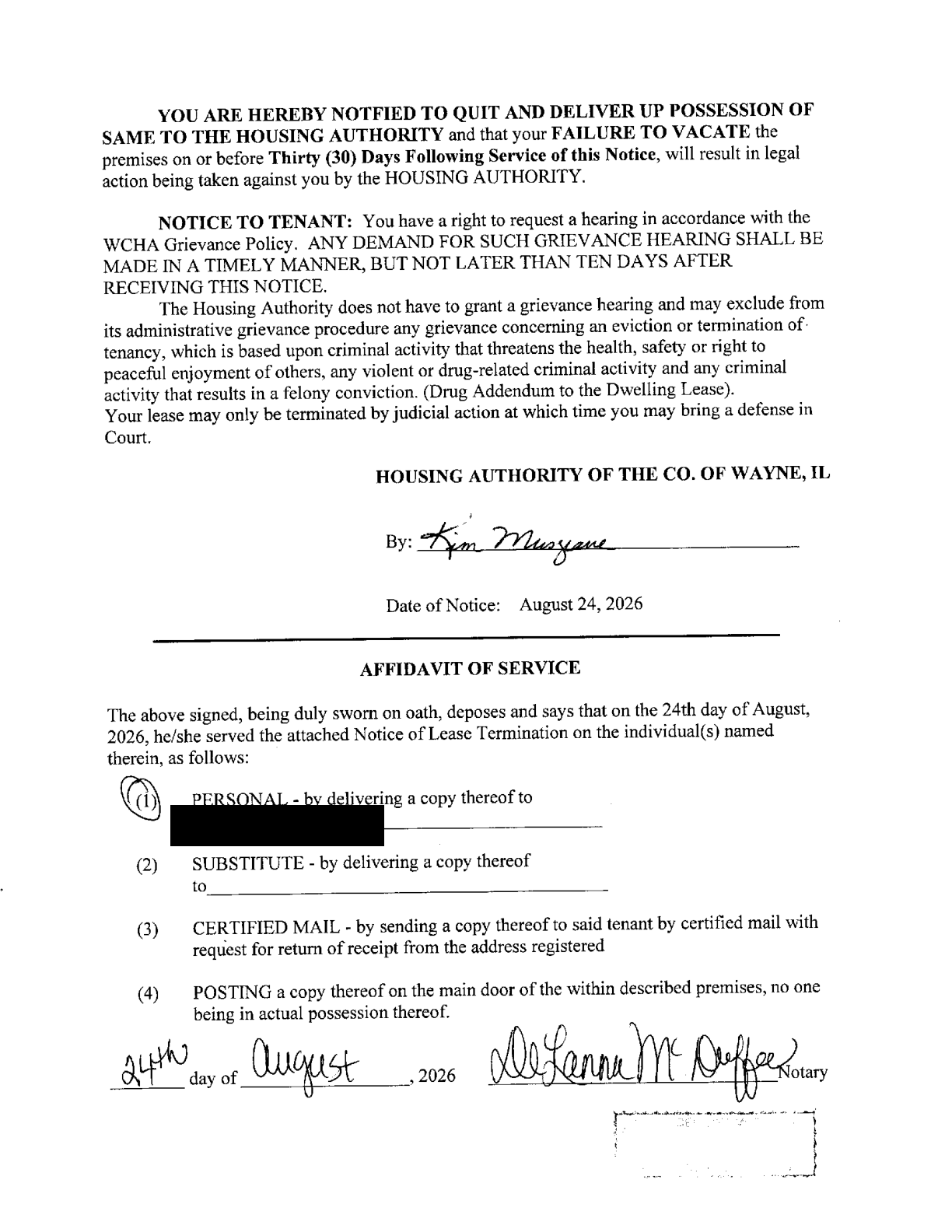
Page 2 of WCHA’s own notice. The hearing-rights language, exclusion language and signature are retained. Private resident information is redacted.
His court packet includes a written request, messages about its delivery, a video reference and certified statements describing delivery to WCHA’s central-office drop box. He states that WCHA then provided no acknowledgment, informal conference, written summary, hearing or decision before service of the lawsuit on October 19.
The motion also addresses the notice’s references to possible grievance exclusions. It argues that WCHA did not actually invoke an exclusion with the statements federal rules require. Instead, the notice expressly told the tenant he could request a hearing.
The missing step is the point
The tenant’s motion is not asking the judge to decide every accusation about his conduct before addressing the grievance failure. It raises a separate issue under section 2-619(a)(9): WCHA claims a completed termination, but it did not complete the required process supporting that claim.
That is what the motion means by affirmative matter. The tenant argues that it gives the court a reason the possession claim cannot proceed as filed, apart from deciding who is right about the underlying accusations.
The grievance process exists so management cannot simply accuse a resident, control access to review, and treat its own allegations as settled. A resident must have a real chance to see the evidence and challenge the action before an impartial hearing officer.
- 24 CFR 966.53(e): impartial hearing officer
- 24 CFR 966.56(a)–(b): prompt hearing, evidence and the opportunity to challenge it
The earlier reporting explains the oversight failure
Our previous investigation addressed WCHA’s changing four- and five-page procedures and its written statement that it does not possess the requested adoption and tenant-participation records.
This follow-up concerns what WCHA expressly told this tenant: he had a right to request a hearing within ten days. He did so. His certified statement says no hearing followed before the lawsuit was served.
WCHA cannot use its own failure to skip the hearing
Our earlier investigation asked WCHA to produce the records showing that it adopted its grievance procedure. WCHA supplied the procedure and said it did not possess the requested adoption and resident-participation records. The copies supplied to residents also changed from four pages to five.
Federal rules require WCHA to adopt a compliant grievance procedure. Producing a handout without the requested adoption records does not establish that it met that requirement. WCHA must put its procedure in order and provide the protections federal rules and its lease require.
That failure does not give WCHA permission to skip a required hearing and go straight to terminating the tenancy. The right belongs to the resident. It does not disappear because management failed to establish or operate its own process. The rule still says that, when the required hearing is requested on time, the tenancy cannot terminate until the grievance process is completed.
- 24 CFR 966.4(l)(3)(iv): termination must wait for the required grievance process
- The lease: hearing rights and incorporated grievance procedure, page 2
WCHA told this resident he could request a hearing. He requested it. WCHA must answer for the missing hearing—not make the resident bear the consequences of its missing process.
Paying a lawyer to obtain the process already promised
The tenant now faces the cost of hiring a lawyer to defend his home. Monster News spoke directly with lawyers who quoted $3,000 for representation. That is the price quoted to obtain legal help—not a fee for requesting the grievance hearing WCHA already promised him.
The point is what brought him here. WCHA told him how to request a hearing. He followed those instructions. Rather than receiving that hearing, he is now defending against a claim for possession, willful-holdover damages, attorney’s fees and costs.
Why should a low-income tenant have to find thousands of dollars to enforce a hearing right already written into his lease?
Monster News helped the tenant prepare his motion to dismiss. The motion raises affirmative matter under section 2-619(a)(9): WCHA claims the tenancy ended, but the required grievance process was not completed. The court packet contains the notice, grievance request, delivery evidence, certified statements and lease. Monster News holds records covering the dispute from its beginning through the civil court filing.
What is HUD measuring—and what is it missing?
Failing to process grievance requests is a management failure. But HUD’s current Management Operations score does not directly count hearing requests, unanswered grievances or hearings actually held. Its three measures are occupancy, tenant accounts receivable and accounts payable.
That is a gap in the score, not permission to ignore the law. HUD’s own assessment rule says PHAS does not measure every requirement and that compliance outside the score is monitored under the relevant regulations and the Annual Contributions Contract.
A favorable performance designation does not answer whether WCHA honored this tenant’s hearing rights. HUD should examine the final notice, the September 2 request, the delivery evidence and the court complaint. Where is the acknowledgment? Where is the informal conference? Where is the hearing notice or decision? How did WCHA move from promising a hearing to claiming the tenancy had ended? HUD should compare those records with WCHA’s signed compliance certifications and issue written findings.
HUD can verify PHA certifications and supporting records. Its rules also allow action against favorable performance designations where certifications are unsupported by facts or there is substantial noncompliance. The relevant provisions include sections 902.79, 902.66 and, for designated small rural PHAs, 902.107. HUD should identify which assessment system applies to WCHA and document its review.
The Office of Inspector General has already documented failures in related oversight. Its February 2022 reasonable-accommodation audit found that 15 of 44 responding PIH field offices did not review PHA accommodation policies. Reasons included missing guidance, reliance on FHEO, and limited resources or expertise. PIH also failed to conduct required civil-rights front-end reviews because it did not believe those reviews were its responsibility. This audit concerned reasonable accommodation; it was not a finding about WCHA’s grievance requests. It does document the danger of HUD offices treating compliance checks as somebody else’s job.
Monster News previously reported its conversations with Yolanda Sue Miller, whom HUD staff identified as a contact for WCHA. The account describes concerns being treated as local governance matters. The demand remains: identify the responsible PIH official, examine the records and issue a written answer. A court will decide the eviction case. HUD must address compliance with the federal program it oversees.
What HUD needs to investigate
This is a request for a documented compliance investigation. HUD should follow the records from the first termination notice through the civil eviction and issue written findings on each step.
The documents below give investigators the notices, requests, lease, delivery evidence, certified statements, complaint and dismissal motion. Monster News has preserved the originals. Unredacted originals and the delivery recording are available to authorized HUD investigators on request through a secure exchange. They are withheld from this public article to protect the resident.
HUD should obtain these records directly from WCHA and compare them with the resident’s evidence:
- Every grievance request and WCHA’s response. Obtain incoming-mail and email records, office drop-box collection records, correspondence, informal-conference summaries, hearing notices, hearing-officer assignments and decisions. Identify who received each request and who decided what happened next.
- The basis for claiming that the tenancy ended. Obtain the complete termination and eviction file, including the evidence supporting management’s allegations, any claimed grievance exclusion, and the instructions authorizing the possession lawsuit. Compare those records with the final notice’s express offer of a hearing.
- The procedure WCHA says governs this tenant. Obtain the operative version, prior versions, board action, adoption records, resident notices and comments, and applicable RAB planning records. Establish who is responsible for each step and who provides an impartial hearing. The earlier reporting documents why these records matter.
- The lease and charges. Compare the grievance terms with WCHA’s actions. Examine the basis for rent, fees, costs and requested holdover damages. A request for money in a complaint is not an award.
- What WCHA told HUD. Obtain the actual signed certifications, supporting records, relevant reviews and findings. Identify WCHA’s assessment category. Compare what WCHA represented with the process this resident actually received.
- What HUD did after notice of the problem. Preserve complaint-routing records, correspondence, referrals and internal decisions. Identify the responsible PIH official and explain what compliance review occurred. The supplied HUD complaint is evidence of what the resident requested; HUD should establish its receipt and handling from its own records.
Monster News asks HUD to require preservation of these records, identify each compliance failure, require correction, and explain how residents will receive the hearings they are owed. HUD should address any unsupported certification or substantial noncompliance under the applicable assessment and enforcement rules. WCHA should not be allowed to treat missing paperwork or an inaccessible process as a substitute for the hearing its own notice promised.
- 24 CFR 966.54: informal settlement and written summary
- 24 CFR 966.56: hearing protections
- Part 902: verification, designation and corrective-action rules
The case has reached court. The missing hearing still matters.
The resident described the October 28 court appearance as brief—about five minutes. He said Judge Vaughn was neutral and respectful, was not ready to rule, and set the motion for a December hearing.
In the resident’s account, Rice appeared confused about whether there were two motions before the court. Vaughn clarified that he was looking at the motion. The resident said Rice did not try to pressure him or take advantage of his lack of a lawyer.
That matters. The resident says he was heard respectfully and was not rushed into losing his home that day. His motion remains for the court to decide. Monster News has not yet obtained the order confirming the December hearing date.
The resident also wants a possible family relationship between Vaughn and Musgrave addressed. Musgrave signed the verification of WCHA’s complaint. The resident believes recusal would be in his best interest. Monster News has not independently verified the reported relationship. This is the resident’s concern, not a finding that the judge acted improperly.
The question raised by the motion is direct: How can WCHA claim the tenancy ended when the lease and federal rules required a grievance process it never completed?
The Authority is seeking possession and damages for remaining in the home. The tenant is asking why WCHA expects the court to enforce the lease while skipping the hearing rights that lease gives him.
Monster News will continue following the case, the grievance requests and HUD’s oversight of WCHA.
Read the documents
Public reading copies. Private resident and representative names, unit identifiers, contact details, signatures and case identifiers have been redacted where present. The original records are preserved privately.
Notices and requests
- April 16 termination notice — 2 pages
- April 19 grievance request — 3 pages
- July 8 termination notice — 3 pages — includes the ledger supplied with the notice
- July 26 grievance request — 2 pages
- July 27 termination notice — 2 pages
- August 5 grievance request — 2 pages
- August 24 final termination notice — 2 pages
- September 2 grievance request — 5 pages
Civil court record
- October 6 complaint for possession and summons — 4 pages
- Motion to dismiss — motion text from corrected submitted packet — 6 pages
- Tenant certified statement — 3 pages
- Representative certified statement — 2 pages
- October 22 corrected-motion submission receipt — 5 pages — submission receipt; not a ruling or proof that the motion was granted
Lease and delivery evidence
- Lease supplied with WCHA complaint — 2 pages
- Four-page grievance procedure supplied as Exhibit E — 4 pages
- September 2 delivery text messages — 1 page
- September 2 delivery video — court exhibit reference — 1 page — the viewing URL is withheld to protect the resident; the original recording remains preserved privately
Related administrative record
- August 19 hardship and repayment request — 3 pages
- Tenant account ledger — 1 page
- Objection to hearing-officer list — 4 pages
- July notice — sheriff service record — 1 page
- Letter raising concerns about service affidavits (undated copy) — 2 pages
- Letter raising concerns about notarization of the July notice — 2 pages
- August 27 institutional-harassment grievance — 4 pages
HUD oversight
- Tenant request for HUD review — 4 pages
Related records already published
- October 28 FOIA response — tenant identifying information redacted
- Earlier four-page procedure
- October 28 five-page procedure
The four-page procedure is also reproduced in the court exhibit above. Duplicate filing copies and blank forms are not repeated. Personal financial fee-waiver forms and account-login records are not included. No written order fixing the reported December hearing date was located in the supplied folder.
Illustration: AI-generated editorial satire by Monster News. The characters and scene are symbolic, not a depiction of an actual hearing.
Comments
Sign in with Google to comment. Your comment posts immediately and is reviewed afterwards. Your address is never published.