
Yolanda Sue Miller: Who at HUD Is Responsible?
Firsthand account and commentary.
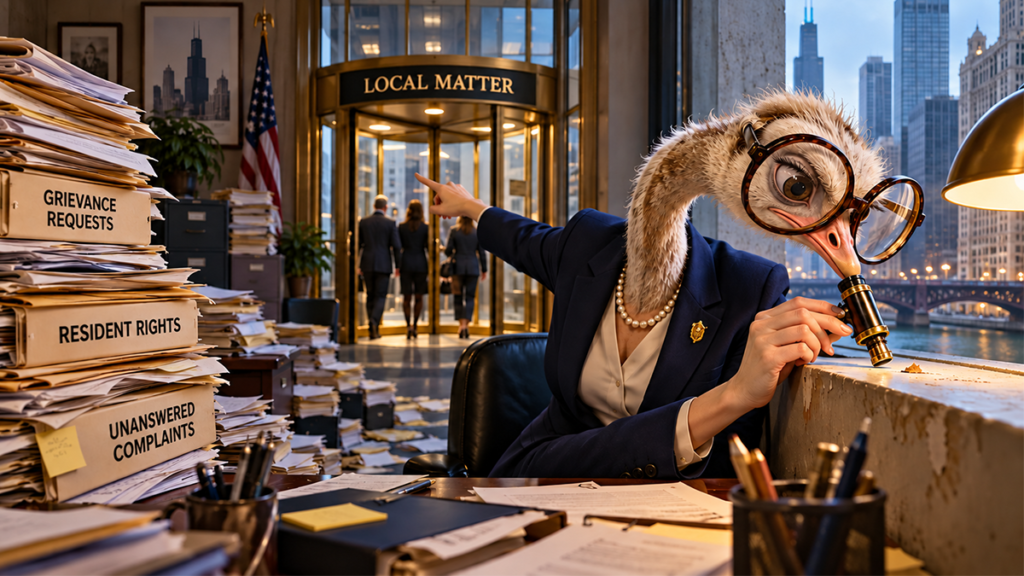
I called HUD looking for accountability. I came away still trying to find the person responsible for it.
Yolanda Sue Miller
312-913-8580
yolanda.s.miller@hud.gov
Ralph H. Metcalfe Federal Building
77 West Jackson Boulevard
Chicago, Illinois 60604
HUD personnel directed me to Yolanda S. Miller in Chicago as a point of contact concerning Wayne County Housing Authority. During our conversations, I understood her explanation to be that concerns about how the authority operates are local governance matters and that HUD’s role is limited to physical inspections or monitoring expenditures.
That is my account of what I understood her to tell me. I have requested written clarification.
The distinction matters because my complaints concern federal requirements governing public housing — not simply whether I agree with a local administrator’s decisions.
Four notices. Four requests. No hearing.
A housing resident received four successive notices seeking to terminate his public-housing tenancy:
| Termination notice | Written grievance request |
|---|---|
| April 16, 2026 | April 19, 2026 |
| July 8, 2026 | July 26, 2026 |
| July 27, 2026 | August 5, 2026 |
| August 24, 2026 | September 2, 2026 |
I helped prepare those requests as the resident’s designated representative. He also submitted a separate institutional-harassment grievance dated August 27, expressly challenging the recurring failure to provide meaningful review.
This resident received no grievance hearing or written determination resolving these requests. I likewise received no responsive hearing notice, grievance decision, or written exclusion determination.
For the September 2 grievance request submission, we have more than a recollection. Contemporaneous messages identify the packet and planned delivery. The resident anticipated foul play and subsequently confirmed completion and sent a video showing the papers being deposited into the central-office drop box as required by the authority.
WCHA then filed an eviction lawsuit alleging that his lease had terminated and that he unlawfully remained in possession. It seeks possession, additional rent, willful-holdover damages, attorney fees, and costs. His first scheduled appearance is October 28.
Those allegations remain for the court to decide. But the administrative question already exists: what happened to the requested grievance process?
Federal requirements are not just local preferences
HUD’s regulation says that when a grievance hearing is required and timely requested as in this case, the tenancy cannot terminate until the grievance process is completed — even if the state notice period has expired.
A separate provision specifies what the termination notice must say when a housing authority elects a permitted exclusion from that process. Those are express federal requirements. 24 C.F.R. § 966.4(l)(3)(iv)–(v).
The August 24 notice expressly told Nathan he could request a grievance hearing. Whether WCHA complied with the governing requirements is central to his defense.
I am not asking HUD to decide the pending eviction case. I am asking who reviews allegations that an agency receiving federal housing funds is disregarding the federal procedures governing its program.
Which office owns the problem?
HUD’s responsibilities are divided, but division should not mean disappearance.
Its Office of Inspector General receives allegations of fraud, waste, abuse, and mismanagement. OIG also expressly says routine administrative complaints belong with HUD program staff or other responsible bodies.
The Office of Fair Housing and Equal Opportunity handles discrimination complaints within its jurisdiction. Not every failure to provide a grievance hearing is automatically a discrimination case.
HUD also has Public and Indian Housing program staff and field-office responsibilities. Its published guidance assigns field offices monitoring functions beyond physical inspections.
There is a narrower rule under which qualifying small rural authorities receive physical-condition-only assessments. But a limited assessment score is not an exemption from federal grievance obligations.
That leaves a straightforward question for Ms. Yolanda Sue Miller and HUD:
Who receives the evidence, reviews compliance, and determines whether corrective action is necessary? Do we simply keep forking over federal tax payer money to an agency that repeatedly defies the federal regulations that govern the disbursement of these very funds?
Residents need a responsible contact
Yolanda S. Miller
HUD employee identified to me as a contact concerning WCHA. Her precise title, portfolio responsibilities, and supervisory chain have been requested in writing.
HUD Chicago Regional Office
Ralph H. Metcalfe Federal Building
77 West Jackson Boulevard
Chicago, Illinois 60604
Telephone: 312-353-6236
Residents seeking assistance should describe their own documented concern, identify relevant dates and prior submissions, and request referral to the official responsible for the applicable federal requirement. Ask for written acknowledgment, a tracking number if available, and the receiving office’s contact information.
I have reported concerns since February with no response from HUD in any form or fashion. I have now asked Ms. Miller to clarify her explanation and identify the appropriate oversight officials.
Federal protections mean little to a resident facing eviction if no one can explain who is responsible for reviewing alleged violations. Residents deserve an answer that identifies an office, a responsible person, and a process.
Monster News HUD Interaction Summary
I am a disabled veteran, and in my time in the military, we developed this practice that we referred to as shamming. The civilian sector, they basically call it busy work. It’s the process of looking like you’re doing something to avoid doing the horrible things that no one wants to do. We got really good at it. It’s government work, after all. We would go as far as scheduling surgeries to certain times of the year so we can be on light duty during annual tasks we wanted to avoid. We’re getting paid the same whether we do it or not.
The entire conversation I had with Yolanda seemed to be laced with the same language we would use to get out of work and left me with this interpretation of shamming or busy work. You know, it’s a little mix of, I don’t understand, dash of incompetence, let me check with my higher ups, Oh, I’m not certain whose that is. You know, the shifting responsibilities game. Typical public employee type attitude. I’m not alone in this opinion. HUD OIG shares this opinion. They just phrase it a little more tactful and respectful than I did, do, and will most likely continue to do.
OIG’s findings about HUD personnel failing to perform oversight!
May 30, 2023 — Report 2023-CH-0004: OIG found field offices inconsistently checked correction of life-threatening deficiencies and generally did not monitor required PHA self-inspections. In its FY 2025 management-challenges report, issued October 2024, OIG continued questioning whether HUD had demonstrated implementation of the corrective protocol.
February 7, 2022 — Report 2022-BO-0001: OIG found PIH failed to conduct required civil-rights front-end reviews and did not believe it was responsible for them. Fifteen surveyed field offices reported not reviewing PHA reasonable-accommodation policies; some relied on FHEO instead.
So monster news leaves you with this, if you ever find yourself trying to get someone at HUD to do their actual job, be assertive and never take no for an answer. Get names, positions, request for your concerns to be forwarded. Get their email and document your interactions with a follow up for clarification. Or even better, start your own media outlet and put these people on blast until accountability comes calling!
Response and corrections: This article recounts my direct conversations and the records I have reviewed. I have requested written clarification from Ms. Miller. Any response will be added as an update, and substantiated factual inaccuracies will be corrected.
Comments
Sign in with Google to comment. Your comment posts immediately and is reviewed afterwards. Your address is never published.