
WCHA’s Grievance Procedure: No Formal Adoption
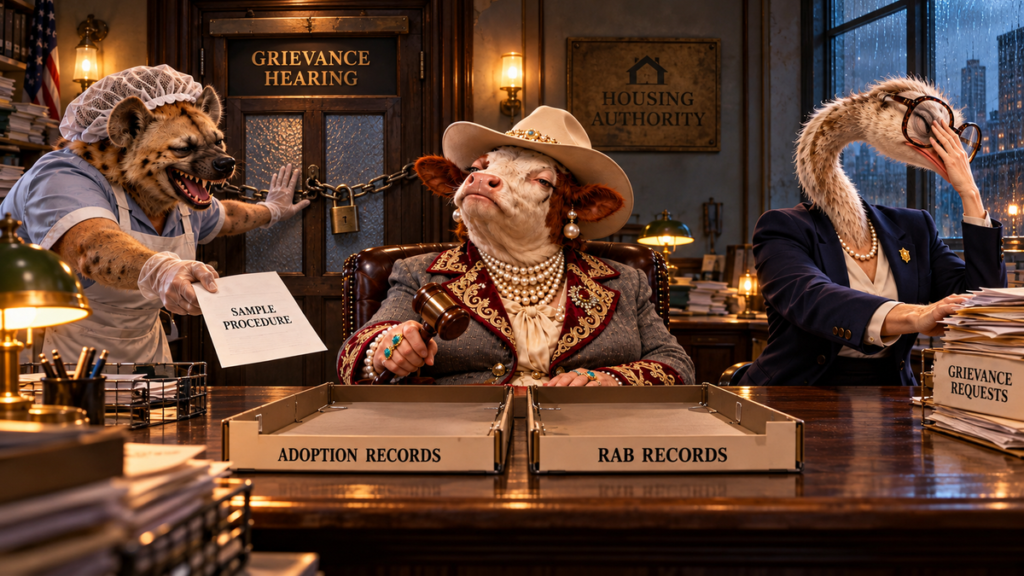
Monster News has been asking Wayne County Housing Authority for its grievance procedure and adoption records for over a year. WCHA supplied a four-page procedure after PAC involvement. It did not supply the adoption records. Now it has supplied five pages—and expressly stated that it does not have the requested records showing adoption and tenant participation.
That is the issue. WCHA is handing residents a procedure it expects them to follow without producing the records showing that the Authority approved it.
This continues our reporting on the water-heater dispute, management’s allegations against the tenant, and the fight for repairs, records and a grievance hearing:
They were asked. They said they do not have the records.
The October 16 request asked for the procedure’s version and effective date; earlier versions and changes; board resolutions, adoption records and meeting minutes; and records showing that tenants were notified and allowed to comment. It also asked for photographs, inspection notes, work orders, entry records and other evidence concerning the tenant’s grievance.
WCHA’s October 28 response supplied the procedure. For the other requested records, it stated: “The Housing Authority is not in possession of 2., 3. and 4.”
Those categories include the adoption records, tenant-notice and comment records, and the requested records concerning the allegations and repairs. WCHA did not simply leave them out of the envelope. It said it does not have them. We take WCHA at its word.
Read the tenant-redacted response and enclosure
WCHA has not provided the records showing when this procedure was adopted, who approved it, or how residents took part. HUD should demand an answer.
Four pages in February. Five pages in October.
After PAC intervened, WCHA made the grievance procedure available in its central office in late February 2026. It was four pages long. It had no version number or adoption date, and WCHA supplied no adoption or RAB records with it.
The version supplied to the tenant in October is five pages long. The earlier copy ends at Section IX. The October copy includes Section X, which explains written hearing decisions, keeping those decisions, residents’ access to decisions with names removed, and whether the decisions bind the Authority.
Read the two documents:
- Earlier FOUR-PAGE handout — ends at Section IX
- FIVE-PAGE procedure supplied October 28 — includes Section X
The reporting files contain seven identical copies of the earlier handout. The difference is there for readers to see. WCHA is supplying a different document while still failing to produce the records behind its adoption.
A January 27, 2026 PAC letter also records an earlier fight to obtain the full policy. WCHA had supplied only part of it in a FOIA response, then provided the full policy after PAC became involved. That letter concerns disclosure of the document, not approval of the procedure.
A hearing process controlled by the person being challenged
The procedure directs certain complaints to a Civil Rights Administrator or Director of Operations. Residents tell Monster News that WCHA has neither office. They identify an executive director, a Section 8 coordinator, a bookkeeper and a secretary, overseen by the board.
Who is the resident supposed to contact? Who takes the complaint when it concerns the executive director? Who makes sure a hearing actually happens?
The water-heater dispute shows why that matters. The tenant challenged management’s claims about the condition of her home and its handling of repairs. She asked for the photographs, inspection notes, work orders and other records supporting those claims. WCHA’s response says it does not possess the requested records in that category.
The tenant needs a way to challenge both the allegations and the failure to repair the water heater. Handing her a procedure that refers her to offices residents say do not exist does not give her that hearing.
When management controls the accusation, the response to the complaint and whether the grievance moves forward, the protection exists on paper while the executive director holds the gate. A board cannot allow that arrangement to replace accountability. Public housing cannot operate as an executive fiefdom.
Monster News has yet to obtain records showing that WCHA has honored even one resident’s request for a grievance hearing. We are also monitoring a pending civil eviction in which the tenant alleges that WCHA denied that right.
A HUD sample is not WCHA’s adoption record
WCHA’s procedure reproduces the text of HUD’s June 2003 sample grievance procedure. PTLA reposted that same document in 2023. There is nothing wrong with using a sample. The issue is whether WCHA approved the procedure through the required process and can produce the records showing it did.
Compare the sources:
- HUD’s 2003 sample — archived original PDF
- PTLA’s 2023 repost of the same sample
- Read the six-page HUD sample (PDF)
The sample was published after HUD put RAB requirements in place in 1999. WCHA cannot answer questions about adoption and resident participation by handing over the sample itself. It must produce its own approval and participation records.
What HUD must enforce
24 CFR 966.52(a) requires a public housing authority to adopt a grievance procedure that meets federal requirements. Subsection (c) requires at least 30 days’ notice to tenants and resident organizations before changes, a chance to submit written comments, and consideration of those comments before adoption. The rule also addresses lease incorporation and furnishing copies.
RAB participation is mandatory in the PHA planning process. Under section 903.13, the Resident Advisory Board helps develop the plan and reviews significant changes. Section 903.21 requires significant changes to go through resident participation, adoption at a public board meeting and HUD review. The RAB reviews and recommends; the governing board adopts. HUD should demand WCHA’s plans, its rules for significant changes, and the records showing the required review and approval.
- Read Part 903
- Read the 1999 rulemaking
- Read Illinois law on the commissioners’ authority, 310 ILCS 10/6
Federal grievance rules require an informal process and a prompt hearing for disputes covered by those rules. Tenants must have access to relevant evidence and a fair chance to challenge management’s account. When grievance rights apply, tenancy cannot terminate until the request period expires and any timely requested grievance process is finished.
- Informal grievance process — 966.54
- Hearing protections — 966.56
- Lease-termination requirements — 966.4(l)(3)(iv)
WCHA receives public housing funds under an Annual Contributions Contract with HUD. HUD’s contract form requires compliance with federal law and HUD regulations. HUD should enforce those duties and its PHA-plan oversight responsibilities. Serious failures can also affect WCHA’s performance designation under the assessment rules that apply to it.
- HUD Annual Contributions Contract
- HUD oversight of PHA-plan compliance — 903.25
- Performance-designation rules — Part 902
Where are the records?
Monster News is asking HUD to investigate whether WCHA ever properly adopted this grievance procedure—or any grievance procedure. HUD should obtain the original files, board actions, RAB records, tenant notices, comments and earlier procedures. It should investigate ignored hearing requests and require a process residents can actually use to challenge the executive director’s actions or inaction.
WCHA was asked for the adoption records. It said it does not have them. Producing another version of the procedure does not answer that. Neither does directing residents to an office they cannot find.
Monster News condemns denying tenants the chance to challenge allegations while taking action against them. HUD should demand the records and enforce the rights WCHA is required to provide.
Monster News will forward this article to Yolanda Sue Miller at HUD, WCHA chairperson Dixie Locke, and WCHA executive director Kim Musgrave, asking each for comment. We will also ask Miller to forward it to her public relations officer and HUD’s Office of Inspector General for comment. We will report on the responses and any records they provide.
Illustration: AI-generated satire by Monster News. This is a symbolic scene, not a picture of an actual meeting.
Comments
Sign in with Google to comment. Your comment posts immediately and is reviewed afterwards. Your address is never published.