
Kim, Oh, Kim Complaint, then Violation

She reported a broken water heater and sought help with her yard. Within seven days she had been entered while she slept, had hot water conditioned on housework, been priced for grass she could not cut, and been told she never called.
Top illustration: Monster News – Kim, Oh, Kim – I thought I saw an easy target!
The first thing the Housing Authority of the County of Wayne did with a maintenance complaint was send a man into the apartment while the tenant was asleep.
The second thing it did was put a price on her grass.
What follows is not a story about a messy yard. It is a story about what an enforcement apparatus looks like when it is pointed at one person, and what it produces when the person on the other end has already asked the agency to stop.
The seven days
September 5. The tenant emails the Authority’s central office. She has been in an accident, she is only just walking again, and she is trying to find someone to mow her yard. Management now knows two things it will later say it did not act on: she is injured, and the yard is a problem she cannot solve herself.
October 12, a Monday. The water heater fails. The office is closed for the holiday. According to her account — and the Authority’s October 19 letter does not dispute the substance of it — she reaches Executive Director Kim Musgrave by afterhours phone and is told the failure is not an emergency and to call back Tuesday.
October 13, Tuesday morning. Before she can call, maintenance is inside the unit. She worked overnight, put her son on the school bus, took her medication and went to bed. She says she woke to find a letter on the door.
That letter, dated that day and signed by Musgrave, confirms the visit in its first line — “our maintenance personnel came to your unit this morning to check your water heater” — and then does something a repair notice has no reason to do. It alleges an unauthorized cat and gives her until Friday, October 16, to supply the name, address and phone number of where the cat has been taken. It calls the unit “very bad condition.” And it makes the repair conditional:
“In order to repair or replace your water heater your unit will need to be cleaned. Get rid of all trash. Sweep and mop all floors. Pick up clothes, do laundry and put it away. Clean up all dishes. Call when your unit is clean so we may do the repair or replacement of the water heater.”
October 13, same day, second letter. A second notice, same date, same signature, generated by the same morning’s inspection:
“We noticed upon inspection that you need to mow your yard. … Maintaining your yard is part of your lease agreement. We will be back on Monday, October 19th to see that your yard has been mowed. If your yard has not been mowed, we will mow it and charge your account an amount ranging from $25.00 to $50.00, depending on the number of times we have previously mowed.”
The two letters did not travel the same way, and that is the whole point of dating them the same day. The water-heater letter was left at the door on October 13 — she woke to it. The mowing letter did not enter the mail until the 15th, and it did not reach her box until the 19th, after the Authority’s people had already been back to look at the yard it described. Same date on both. Same signature. One arrived in hours; the other arrived after the inspection it announced.
This is the yard that notice describes. The photographs were taken the same day the Authority came back to inspect it on the 19th.
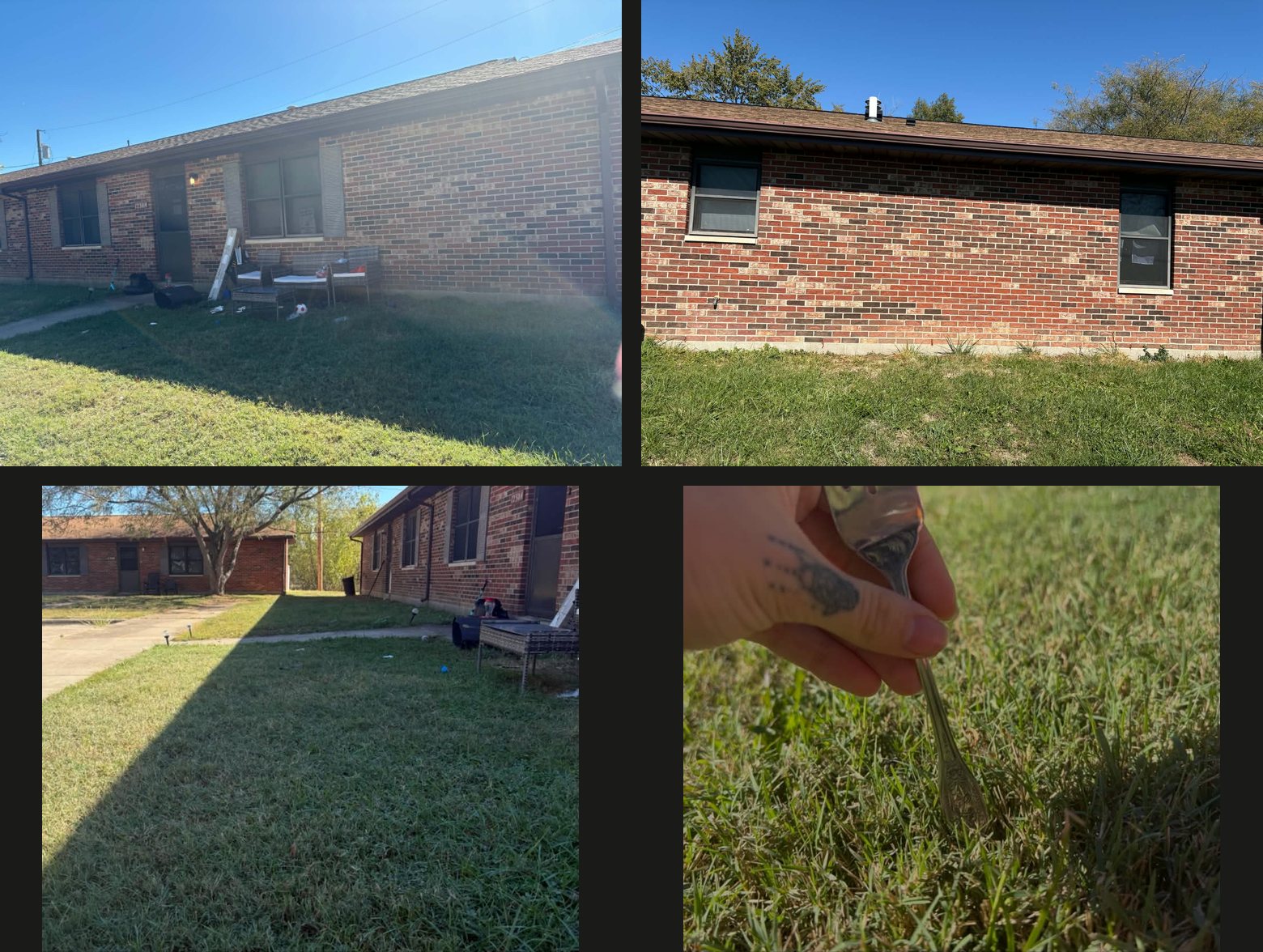
October 16, Friday, 9:24 p.m. The tenant’s representative emails the Authority a formal grievance: the repair failure, the unannounced entry, the absence of any notice of grievance rights, and a request for an individualized assessment and reasonable accommodation for her physical limitations. It designates a representative, invokes Section 15 of the lease and 24 CFR Part 966, and asks that the repair proceed. It lands on the same day as the cat deadline.
October 19, Monday, between 5 and 5:30 a.m. The carbon monoxide detector in the hallway went off. According to the tenant, she woke her son, got him to the door, aired the unit out and reset the alarm herself. She has been relighting the water heater by hand for the last week — a woman with a cast on her right hand and a boot on her right foot — because the pilot will not stay lit.
October 19, Monday, 11 a.m. This is the day the mowing notice said the Authority would return. An office worker is at the door shortly after 11; a maintenance vehicle arrives at 11:26. The mailed notice reaches the unit that day — the tenant says in the afternoon — so the deadline expired hours before the letter was delivered.
The heater was already burning when they walked in — she had relit it herself after the alarm. They found it running, concluded it was working, and left. In the tenant’s account she told them about the carbon monoxide alarm before dawn and about relighting the unit by hand every day, and was told that because it was working there was nothing to repair.
The Authority’s letter that day reaches the same conclusion in writing. It records that on the crew’s earlier visit they could not get the unit lit, went back, and then “were able to light the water heater” — two attempts to start an appliance that is not supposed to need starting. It closes the subject with: “As far as we knew your water heater was working.” Then:
“You never called to report that it had went out again.“
The office had received that report in writing, at its own address, three days earlier. The October 19 letter does not mention the grievance, does not answer it, and does not acknowledge that one exists.
The alarm before the inspection
Put the two events of October 19 in order, because the Authority’s account does not.
Before daylight, a carbon monoxide detector sounded in a duplex where a gas appliance had been failing for a week. Six hours later the Authority’s crew arrived — for a visit scheduled by a letter about grass that had not arrived — and left satisfied that the heater was working, because she had lit it herself before they got there. She says she told them about the alarm before they left.
A pilot light that will not stay lit is a service condition, not a housekeeping one. It is also the kind of fault that can put unburned gas into a room between relights, which is why the alarm matters more than the flame: a heater that happens to be burning when the inspector arrives says nothing about what it did at five in the morning, or what it will do tonight.
On her representative’s advice, the tenant called the Fairfield Fire Department that afternoon before going back inside. Firefighters went through the unit with a four-gas detector — the meter that reads carbon monoxide, oxygen, flammable gas and hydrogen sulphide — and it read clean. According to the tenant, they told her to call again if the alarm sounded, because an intermittent fault is precisely the kind that reads clean between events.
So the record now contains three positions on one appliance. The tenant says it fails, repeatedly, and that a detector sounded. The Authority wrote that maintenance lit it and that “as far as we knew” it was working. And the fire department found no reading on the afternoon it was called.
All three can be true at once, and that is the problem. A heater that relights and runs is not a heater that is fixed. Nothing in the Authority’s October 19 letter describes a diagnosis, a repair, a service record, or a plan for the next time the pilot goes out. The letter treats “we lit it” as the end of the matter. For a tenant with a cast and a child in the unit, it is the beginning of the next morning.
Monster News is going to take a rare liberty and add a fourth to this mix, A. O. Smith directly addresses a pilot that repeatedly goes out: techinicans should treat repeated pilot outages as a troubleshooting problem with identifiable potential causes. Successfully relighting it once does not establish that the recurring problem has been corrected.
What the sequence is, and what it is not
The tenant calls it a pattern — a history of harassment that began when she complained in the past. Her representative does not dismiss the notion given the hisotry of violations following maintence complaints by Kim Musgrave, he puts a narrower version forward as a temporary placecard: unreasonable enforcement.
Monster News is not adopting that characterization as fact, because motive is not in these documents. What is in the documents is a sequence, and the sequence has a shape:
- A request for help with the yard in September.
- A reported emergency in October.
- An unannounced entry, and two notices with deadlines and consequences, both dated the day of that entry.
- A written grievance on the 16th.
- An inspection and a denial on the 19th.
Nothing in that sequence shows why the Authority did what it did. It does show that at no point did a complaint produce a pause. The grievance produced more enforcement, not less — and a letter denying a report the agency had already received.
That matters because federal law is explicit about what a pending grievance is supposed to do to an enforcement action.
The rule the sequence runs through
When a public housing agency proposes adverse action other than lease termination — and “imposition of charges for maintenance and repair” is named in the regulation as adverse action — the agency may not take that action until the tenant’s time to request a grievance hearing has expired, and, if a hearing was timely requested, until the grievance process is complete (24 CFR 966.4(e)(8)(i)–(ii)(B)). The notice that triggers that protection must inform the tenant of the right to request a hearing.
Neither October 13 notice does. The mowing notice threatens a charge against her account and never mentions a hearing. The water heater letter conditions an essential service on housework and never mentions one either.
The tenant was not without a procedure. The Authority has a four-page grievance procedure, incorporated by reference into every lease, and it is more protective than anything the notices disclosed:
- A grievance must be presented within ten days of the grievable event — a window her October 16 email met with days to spare.
- Complaints involving discrimination, harassment, or disability rights “will be referred to the Civil Rights Administrator or Director of Operations”.
- The tenant may be represented by counsel or any other person.
- At a hearing, the tenant first shows entitlement to relief, and then the PHA “must sustain the burden of justifying the PHA action or failure to act”.
- Hearing officers come from a slate the Authority itself nominates, which “may include PHA Board members, PHA staff members, residents, professional arbitrators, or others.”
That last bullet is the quiet problem. A tenant contesting the executive director’s decision draws her hearing officer from a list the executive director’s agency assembled. The procedure requires nominees to stand aside where they have a personal interest, and federal regulation demands an impartial decision-maker. But the agency nominates the pool, appoints the panel, and sets the calendar.
An enforcement system can be procedurally correct and still be aimed. The question is whether anyone outside it ever looks. Since it’s inception in 1969 the Wayne County Housing Authority has never been able to produce a single documented record of a tenant being afforded the due process rights the grievance procedure is intended to preserve.
Three duties, three deadlines
Look at what the Authority demanded in six days, and at what it offered in return.
| Date | Demand | Consequence | Right to object disclosed |
|---|---|---|---|
| Oct 13 | Identify where the cat was taken | Deadline Oct 16 | None |
| Oct 13 | Clean the unit — trash, floors, clothes, laundry, dishes | Hot water withheld until done | None |
| Oct 13 | Mow the entire yard and weed-eat the perimeter | $25–$50 charge; return visit Oct 19 | None |
Three separate obligations, three separate clocks, one signature, and not one line telling the tenant how to challenge any of it.
The tasks are not equivalent, and that is the point. Cleaning a unit is a lease duty. Cutting grass is a lease duty — if the lease validly assigns it. Restoring hot water is not a tenant duty at all; it is the Authority’s, under its own lease and under federal regulation. The October 13 letter converted the agency’s obligation into leverage over the tenant’s.
Then there is the exemption nobody mentioned. Federal regulation allows a public housing lease to assign “seasonal maintenance or other maintenance tasks” to tenants, subject to a command with no qualifier: “The PHA shall exempt tenants who are unable to perform such tasks because of age or disability” (24 CFR 966.4(g)). The tenant’s hand is in a cast with surgical pins; her foot is in a walking boot. She had told the Authority about the injury on September 5. The mowing notice says nothing about an exemption, asks nothing about her capacity, and describes no process for requesting one.
The lease does state the duty, and the wording is the whole case. Paragraph 9(M), under the tenant’s obligations, requires the tenant to “perform seasonal maintenance or other maintenance tasks in a single-family duplex and row houses in accordance with the rules established in the tenant’s handbook.”
Two things follow from that sentence. The lease delegates the task but not its terms: the scope, the schedule and any charge are set “in accordance with the rules established in the tenant’s handbook,” and the mowing notice cites no handbook rule, quotes none, and does not attach the handbook. And the paragraph contains no exemption — no carve-out for a tenant who cannot perform the work, no procedure for asking, nothing acknowledging that one exists. Federal regulation requires that carve-out in terms, and requires the assignment itself to be included “in good faith and not for the purpose of evading the obligations of the PHA.”
Whether the accommodation policy elsewhere in the lease supplies what 9(M) omits is not something Monster News can say from the documents it holds. What it can say is that a clause assigning the work, standing on a handbook the notice never mentions, and saying nothing about disability is exactly the gap the mowing notice walked through.

And the charge itself: “$25.00 to $50.00, depending on the number of times we have previously mowed” prices a service against a history, and discloses neither. The lease supplied to Monster News contains one charge clause — lettered (j) in the copy on file, and poorly rendered by the scan — under which the tenant agrees to “pay reasonable charges (other than for normal wear and tear) for the repair of damages to the premises … caused by the Tenant, his household members or guests.” Grass that grew is not damage the tenant caused, and mowing is not a repair. The lease elsewhere points tenants to a Tenant’s Handbook “covering special charges,” which the notice neither cites nor attaches — the same handbook that 9(M) makes the yard duty conditional on.
Why the omissions matter more than the demands
A mowing bill of twenty-five dollars is not, by itself, a scandal. What makes this a story is that every demand arrived wrapped in the same omission.
The notices assert duties without naming the clause that creates them. They price penalties without producing the schedule. They condition a repair on chores without saying what condition actually blocked the repair. They threaten charges without disclosing the right to contest them. And they tell a tenant with a documented disability to perform a task the regulation says she must be exempted from.
Any one of those could be clerical. All of them, in six days, from one office, after a complaint, is a method.
It is also a method with a name in the record. The October 19 letter does not say “we are enforcing.” It says she never called — a statement the agency’s own inbox contradicts, and which converts her complaint into a failure to communicate. That is how an enforcement file is built: not with the yard, but with the note that the tenant didn’t respond.
What would settle it
The question Monster News is putting to the Authority is narrow: what policy authorized each of these three demands, and what procedure was the tenant supposed to use to challenge them?
The documents that answer it are the Authority’s own:
- The Admissions and Continued Occupancy Policy — whether a 966.4(g) exemption process exists at all.
- The reasonable-accommodation policy and any request log for September and October.
- The schedule of charges behind the $25–$50 range, and the Tenant’s Handbook the lease refers to.
- Board minutes for September and October, and the annual PHA Plan.
- The work orders for the October 13 inspection and the October 19 visit, and every service record for the water heater, including its model and serial.
- The fire department’s run report for October 19, and the 911 or dispatch record if one exists.
- Any detector or alarm record the Authority keeps, and its own policy for gas-appliance and carbon-monoxide calls.
- The notice file for October 13, to show whether the mowing letter went to one address or many.
Until those arrive, the record supports a statement narrower than “harassment” and more uncomfortable than “a mistake.” A public housing authority answered a maintenance request with an entry, a chores list, a cat ultimatum and a bill for grass; answered a written grievance with a denial that the grievance existed; and returned on the deadline it had set to inspect a yard it had already decided was a violation.
The tenant’s representative calls that targeting. Monster News will report what the files say.
Read the federal rules
- 24 C.F.R. § 966.4(e)(3), (5) and (7) — repairs, supplied facilities and hot water.
- § 966.4(g) — tenant maintenance and the exemption for tenants unable to perform tasks because of age or disability.
- § 966.4(b)(2)–(4) — charges, their basis and when they become collectible.
- § 966.4(e)(8) — notice and grievance rights concerning proposed adverse action.
- § 966.4(j) — entry during tenancy.
- § 966.53(e) — impartial hearing officers; § 966.56 — hearing procedures and the burden of justification.
These links identify the federal provisions relevant to the reporting. They do not independently establish the events described in the tenant’s account or resolve the disputed application of the rules.
Comments
Sign in with Google to comment. Your comment posts immediately and is reviewed afterwards. Your address is never published.