
No Hot Water, No Notice

A Fairfield mother reported a broken water heater on a holiday Monday. By Tuesday morning a maintenance man was inside her duplex while she slept. By that afternoon the repair had a condition attached to it, and by the end of the week the only body that could have corrected it had said nothing at all.
Top illustration: the door opens whether or not anyone answered it. Illustration: Monster News.
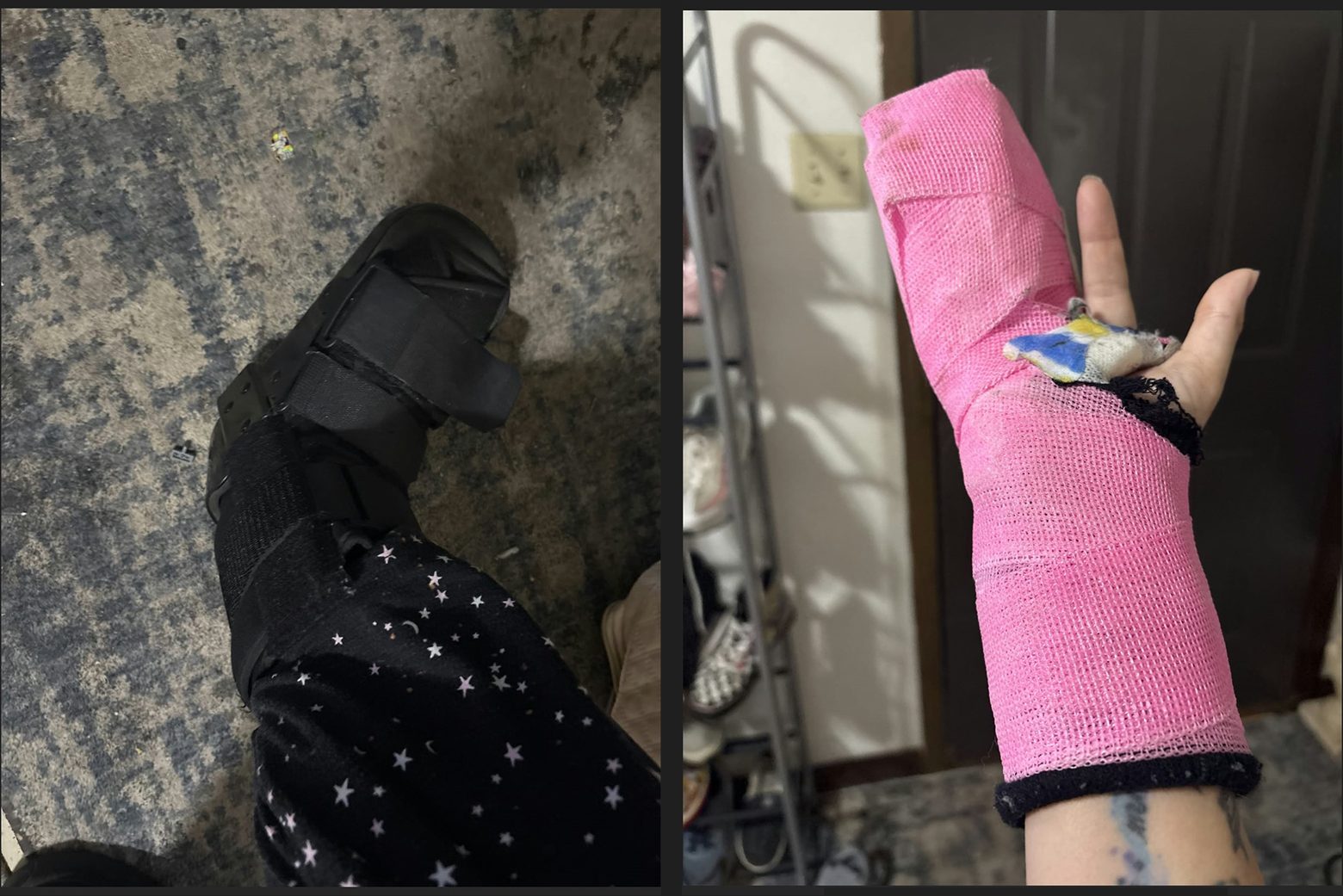
On Monday, October 12, a resident of a Housing Authority of the County of Wayne duplex in Fairfield pulled her winter clothing out of storage to wash it. The weather had turned. She was a few weeks out of surgery, working nights, raising a preteen son, and doing all of it one-handed with a boot on her right foot.
She turned on the tap and got cold water.
The Housing Authority office was closed for the holiday. According to her account, she called Executive Director Kim Musgrave on her cell phone and was told the broken water heater was not an emergency and that she should call back during business hours. She said she would.
She never made that call. Before she could, someone was already inside her home.
What the documents show
A signed letter dated October 13, 2026, on Housing Authority of the County of Wayne letterhead and signed by Musgrave, confirms that “our maintenance personnel came to your unit this morning to check your water heater.” It then tells the resident her unit “is in very bad condition,” alleges an unauthorized cat, demands the name, address and phone number of where the cat was taken by Friday, October 16, and sets out what must happen before the heater is fixed:
“In order to repair or replace your water heater, your unit will need to be cleaned. Get rid of all trash, sweep and mop floors, pick up clothes, do laundry and put it away, clean up all dishes. Call when your unit is clean so we may do the repair or replacement of the water heater.”
The letter contains no notice of the resident’s right to grieve the decision, no deadline for challenging it, and no explanation of what condition in the unit actually prevented a repair.
The resident was asleep when the visit happened. She had worked overnight, taken medication, put her son on the school bus and gone to bed. She did not know anyone was coming. According to her account, she woke to find the letter on her door.
Security-camera images supplied to Monster News show a service truck in the driveway and a man walking up the unit’s front path. Motion alerts are timestamped 9:15, 9:20 and 9:25 that morning; a separate camera still carries a visible timestamp of 1:33 p.m. The resident’s representative says maintenance came twice that day — once in the morning for the heater, leaving without repairing it, and again later to deliver the letter. The screenshots establish that someone was there. They do not establish entry times on their own.
The resident called Fairfield police that day to report the entry.
Judge for yourself
The resident photographed her home after she woke and found the letter. Monster News is printing those photographs, and the letter’s own words beside them, because the comparison is the story — and because readers are entitled to see the evidence rather than take anyone’s word for it.
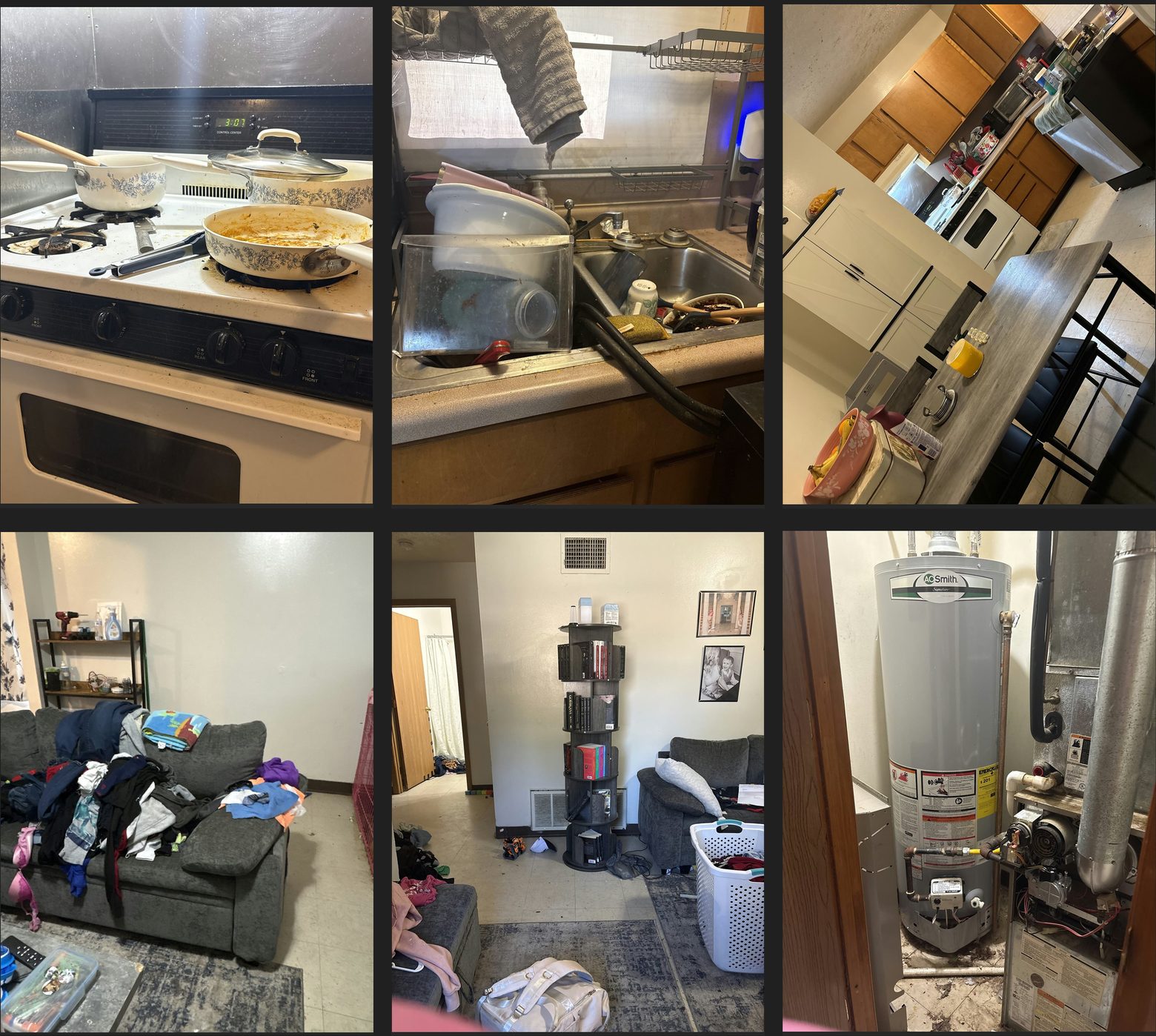
Set the letter’s demands against what is visible in that set:
| The letter says | The photographs show |
|---|---|
| “Get rid of all trash” | No large trash accumulation in the rooms photographed. Scattered belongings, small debris, a broom by the closet. |
| “Sweep and mop floors” | Floor visible and walkable in every photographed room, including directly in front of the utility closet. Dirt on the closet floor itself. |
| “Pick up clothes, do laundry and put it away” | Winter clothing sorted on a loveseat and in a basket — laundry in progress, not laundry abandoned. |
| “Clean up all dishes” | A day’s dishes in a double sink and three pans on the stove — in the same unit whose hot water had been out since Monday. |
| Repair will follow cleaning | Nothing in the photographs stands between the doorway and the heater. The letter names no obstruction, no clearance, no code requirement, no hazard. |
It is a lived-in home, photographed by someone who is not a meticulous housekeeper and who says so. It is not the picture drawn by “very bad condition.” There is no trash pile in these frames, and there is no pile between the maintenance man and the water heater he came to check.
So: was this a repair visit with a housekeeping lecture attached, or was a list of ordinary household conditions assembled into a precondition for restoring hot water to a woman with a cast on her hand and a boot on her foot? Was the executive director discharging a duty, or using the authority of her office to press a tenant who had already complained?
Those are questions about motive, and photographs cannot answer motive. What they can do is settle the justification that was actually offered. The letter says the unit is in very bad condition and must be cleaned before the repair. The photographs say otherwise about the condition, and the letter itself says nothing about what in that condition prevented a plumber from working.
Readers can weigh that for themselves. Monster News draws one conclusion and leaves the rest to the record: whatever the reason for that list, it was not a reason found at the water heater.
The rules, in their own words
We are not asking anyone to take our word for the standard. Here is the lease the Authority issues, supplied to Monster News, quoting the paragraphs that matter:
8(c) — Management shall “make necessary repairs to the premises.”
8(e) — Management shall “maintain in good and safe working order and condition” the electrical, plumbing, sanitary, heating, ventilating and other facilities and appliances supplied or required to be supplied by Management.
8(g) — Management shall “supply running water and reasonable amounts of hot water” and reasonable heat at appropriate times of the year, except where the unit is not required by law to be equipped for that purpose or is supplied through an installation within the exclusive control of the tenant.
12(a) — Management may enter only “upon reasonable advance notification,” during reasonable hours, for routine inspections, maintenance, improvements or repairs. A written statement specifying the purpose of the entry, “delivered to the premises at least two days before such entry shall be considered reasonable advance notification” — two days being 48 hours.
12(b) — Entry may proceed “at any time without advance notification when there is reasonable cause to believe that an emergency exists.”
The federal side is equally plain. 24 CFR 966.4(e)(8) requires a public housing agency that proposes to terminate tenancy — or to take other adverse action — to give the tenant written notice of the grounds and of the right to a hearing. The Authority’s own grievance procedure sets out how a tenant challenges a management decision.
Compare that with the letter: an allegation of unauthorized pet, a demand for cat-relocation information within three days, and a repair made conditional on housework — with no notice of any right to contest any of it.
You decide. Read the eight photographs. Read the five paragraphs above. Read the letter. Ask why a maintenance man was in a sleeping woman’s home on a Tuesday morning with no notice, and why the repair she asked for on Monday came back with a list of chores attached and no way to appeal it.
Three duties, one letter
The Authority’s standard lease form, a copy of which was supplied to Monster News, separates the obligations cleanly. Paragraph 8(c) requires management to make necessary repairs. Paragraph 8(e) requires management to keep supplied appliances and plumbing “in good and safe working order and condition.” Paragraph 8(g) requires the Authority to supply running water and reasonable amounts of hot water.
Housekeeping is a resident duty, and it lives in a different paragraph — paragraph 9(f) and 9(g). Nothing in the lease makes necessary repair of a supplied appliance conditional on finishing the dishes.
Those three duties are not a local preference. They are HUD’s own lease requirements, written into 24 CFR 966.4(e)(3), (e)(5) and (e)(7) in almost the same words, and a public housing lease is required to carry them.
The entry has its own paragraph. Paragraph 12(a) requires reasonable advance notification before entry for routine maintenance and repairs, and fixes the standard for it: written, purpose-specific notice delivered at least two days — 48 hours — ahead. Paragraph 12(b) carves out genuine emergencies, and 12(c) requires a written statement of the date, time and purpose of entry when the tenant is away.
That exception is worth sitting with. On Monday, the executive director is reported to have said the failure was not an emergency. By Tuesday morning, no notice had been given, and the resident — asleep after a night shift — did not answer a door nobody told her would be knocked on.
Who sent him?
This is the part the letter cannot answer, because the letter was written after the fact.
Somebody authorised that visit. In a housing authority of this size, the work order does not generate itself: the executive director runs the office, sets the dispatch, and is the person who decides whether a repair is an emergency, a routine job, or something that can wait behind a housekeeping list. On Monday she is reported to have told the resident the heater could wait. On Tuesday morning it could not wait for a phone call, a notice, or an answer at the door.
Her representative puts it bluntly: the executive director had no right to send that man to that address on those terms, and the fault for sending him sits with the office that sent him — not with the employee who was told to go.
The man in the camera images is identified by the resident and her representative as Greg Boyd, a Housing Authority maintenance employee. That identification comes from them, not from an independent facial recognition or from Authority records. Monster News is printing the name because the entry happened and because the man who walked up that path was doing the Authority’s work; it is not asserting that he knew the notice had never been sent.
That distinction matters, and the resident’s own representative makes it deliberately. No work order, dispatch record, or internal message has been produced to Monster News. What Boyd was told, whether he believed notice had been given, and whether he was authorised at all remain unknown.
What is asserted, by her representative, is criminal trespass to a residence under 720 ILCS 5/19-4 — knowingly entering or remaining in another’s residence without authority. That is an allegation. No charge has been filed, no prosecutor has reviewed it, and no court has made a finding. A lease violation and a criminal offense are different questions with different elements, and Monster News does not treat one as proof of the other.
But the civil question does not depend on a prosecutor. If the Authority’s own lease requires notice before routine entry, and the Authority’s own executive said the matter was not an emergency the day before, then the Authority has to explain what authorised the door to open.
The board that is supposed to catch this
The Housing Authority of the County of Wayne has existed since 1969. It is not a startup, not a one-person office, and not a body without a chain of command. Above the executive director sits a board of commissioners whose job is not to run repairs — it is to make sure the institution’s policies and practices are lawful, that the people it employs are supervised, and that when something goes wrong the institution corrects it instead of absorbing it.
The commissioners are Dixie Locke, Tim McBride and Doyle Hucker.
Her representative’s allegation is not that they personally dispatched a maintenance man. It is that they are captured — that they carry water for an executive director they consider a friend, that oversight has become a formality, and that tenants pay for the silence. Monster News has not seen board minutes, a complaint log, or any record of the board taking up this matter, and is not asserting as fact that the commissioners knew of this dispatch, protected anyone, or acted in bad faith. The characterization is her representative’s, and it is offered as such.
What can be said without qualification is what the record shows: six days after a resident reported no hot water, an entry she says was unannounced, and a letter conditioning the repair on housework, the governing body of the Authority has produced no public response, no policy statement, and no indication that it has asked a single question about how that visit came to be scheduled.
That silence is the structural story. A captured board and a negligent board look identical from the outside on the day nothing happens. Both leave the resident holding a letter that says clean the house and we will think about your hot water.
The liability question follows the same line. A maintenance worker following an instruction is not the deep pocket and not the decision-maker. The Authority is. Its lease creates the duty, its executive creates the dispatch, and its board exists to see that both hold. If the notice requirement was ignored, the exposure does not stop at the person who turned the key — it runs to the institution that sent him and to the commissioners who are supposed to be watching it.
The deadline that ran out quietly
The letter gave the resident until Friday, October 16 to supply contact information for a cat.
The lease’s prohibition is narrower than the letter implies. Paragraph 20 forbids dogs, cats, fowl or other animals “kept on the premises” — kept, not present. Illinois reads that word as requiring care, custody or control, and the letter alleges none of the three; it says only that she “had unauthorized pet cat in your unit.” The full legal question, and why a food bowl is not proof of anything, is the subject of our companion piece in Leads.
She does not own a cat. Her representative says the animal in question is a neighbourhood cat that keeps slipping inside when a door opens, that the resident recognises it and puts it back out, and that she has no idea how it got in that morning. It may have walked in behind her son on his way to the bus. It may have walked in when the door was opened while she slept. Neither explanation is established, and Monster News is not asserting one.
What is established is that a public housing authority wrote a deadline into a repair dispute over an animal its tenant says is not hers — and that the same letter says the heater will not be fixed until the house is cleaned.
On October 16 at 9:24 p.m., the resident’s representative emailed the Authority a grievance setting out the repair failure, the entry, the missing notice of rights and a request for an individualized assessment and reasonable accommodation for her physical limitations. It was forwarded the following evening. The Authority’s own grievance procedure provides an initial presentation window for a grievable event; the copy supplied to Monster News is a scan and the exact interval is being confirmed against the original.
What we are still asking
The work order that sent a maintenance man to that address, the 48-hour notice the lease requires, any dispatch or access records, and the board’s minutes for the period have not been produced. The Authority has issued no public statement on the matter.
The address, the resident’s identity and the identities of her family members are withheld. The collages above show injuries and household conditions; no identifying detail appears in them.
There are additional, extremely concerning aspects of this matter that are reportedly under investigation by the Fairfield Police Department. Monster News is withholding those details while that investigation is pending.
Regulations referenced in this article
Read the source text for the federal provisions discussed above:
Comments
Sign in with Google to comment. Your comment posts immediately and is reviewed afterwards. Your address is never published.