
HUD’s Authority
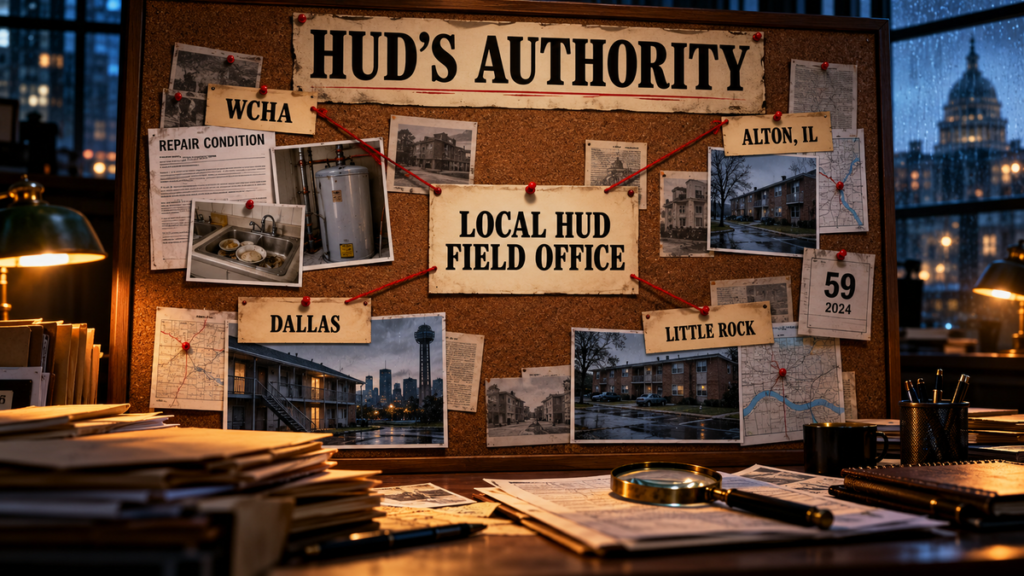
HUD has a duty to monitor public-housing compliance. It has addressed failed board oversight, broken grievance procedures and improper treatment of tenants at other housing authorities. Wayne County residents are raising those kinds of problems now. Yolanda Miller’s written response sends a resident back to the board.
In an October 29 email, Yolanda Miller of HUD’s Office of Public and Indian Housing wrote:
Our office received your complaint and I wanted to follow-up. Our office does not directly oversee the Executive Director. She was hired and is supervised by the Board of Commissioners. Please raise your concerns with the board for resolution as you have the right to attend the Board meetings.
The board supervises the executive director. HUD oversees the Housing Authority’s compliance with federal public-housing requirements. Those responsibilities exist together.
In an October 29 email shared with Monster News, Kathy Sands, editor of The Villagers’ Voice, described the response as “kicking the can down the road.”
Monster News agrees. Miller’s response kicks the can down the road. Residents are presenting evidence of WCHA’s noncompliance, and HUD is sending them back to the board whose oversight is part of the complaint.
The question was not whether HUD hires or fires Kim Musgrave. The question was how WCHA could put a repair condition in writing, send it to a resident on agency letterhead, and leave the resident seeking help outside the agency.
The Authority’s own board packets show substantial federal funding: $186,145.50 in HUD subsidies in the March 18, 2026 packet and $81,646.33 in the April 15 packet. Those two entries alone total $267,791.83. These are the amounts reported in those packets, not a claim that the same amount arrives every month.
This is an accountability question for HUD. WCHA receives federal public-housing assistance. What compliance checks accompany that funding? What records did HUD request, what failures did it identify, and what did it require the Authority to correct? HUD should disclose its funding and monitoring records so residents can see what oversight their Housing Authority actually receives.
The complaint includes the board’s failure to address management’s conduct. Referring the resident back to that board leaves the federal oversight question unanswered.
The board is part of the complaint
Monster News reports that commissioners have been copied on correspondence about the problems covered in this investigation. Residents describe a board that protects management rather than addresses their complaints. HUD should examine what commissioners received, what they did, and what they required management to correct.
Telling residents to attend a meeting does not answer those questions. Illinois law gives the public an opportunity to address officials at an open meeting. That right does not guarantee an answer, a place on the agenda for a decision, or a hearing on a tenant’s grievance. Public comment is not a substitute for the grievance process required by HUD.
The board’s monthly meeting schedule also does not answer a resident waiting for a working water heater. A resident can speak, leave the room, and still have the same problem.
- Illinois Open Meetings Act, Section 2.06(g)—public comment
- 24 CFR Part 966—public-housing leases and grievance procedures
The signed letter is a warning about the system
The sequence matters:
- Monday, October 12: The resident reports the water-heater problem, according to her written grievance.
- Tuesday, October 13: Maintenance visits. Musgrave signs the letter conditioning repair or replacement on cleaning, including dishes and laundry.
- Friday, October 16: The resident disputes those allegations and requests the evidence, including photographs, inspection notes, work orders, entry records and communications supporting the allegations and repair conditions.
- Wednesday, October 28: WCHA responds that it is not in possession of the records requested in items 2, 3 and 4. Item 4 specifically covers that supporting evidence.
- Thursday, October 29: Miller tells the resident to take her concerns to WCHA’s board.
WCHA put the condition in writing, then expressly denied possessing the requested records supporting it. What supported that decision? What policy allowed it? Why did the board not correct it? Those are agency-compliance questions for HUD to examine.
An October 13 letter signed by Musgrave tells a resident: “In order to repair or replace your water heater your unit will need to be cleaned.” Its list includes doing laundry, putting clothes away and cleaning dishes. It ends: “Call when your unit is clean so we may do the repair or replacement of the water heater.”
That is WCHA communicating an agency decision. How did that become an acceptable response to a repair problem? What policy authorized it? What did the board do when it learned about it?
The letter does not identify a blocked water heater or a specific hazard preventing access. HUD should obtain the work orders, inspection notes, photographs and repair policy and require WCHA to explain the condition it imposed.
The complaint forwarded to HUD says workers restarted the heater. Monster News now reports that it continues to malfunction and that a lasting repair remains unresolved roughly three weeks after the problem began. A restart and a completed repair are not the same thing.
Section 966.4(e) requires a PHA to maintain safe and sanitary housing, make necessary repairs, maintain plumbing and other facilities, and supply reasonable amounts of hot water. Tenants also have housekeeping obligations under subsection (f). Both sets of duties apply. A demand to do dishes does not answer whether WCHA met its repair obligations.
The water heater is one example. This investigation also covers missing grievance hearings, disputed charges, requests for evidence, and the Authority’s failure to produce requested grievance-procedure adoption records. Residents report that maintenance complaints have been followed by management allegations against them. That reported pattern calls for examination of the records and dates, including possible retaliation.
- WCHA History of Non-Compliance
- Kim, Oh, Kim Complaint, then Violation
- WCHA’s Grievance Procedure: No Formal Adoption
- WCHA Grievance Gatekeeping
HUD already has grounds to ask questions
The board’s own January 15, 2025 minutes record Resolution 25-3: commissioners voted 4–0 to table the “NSPIRE Inspection, Appeal, etc.” until hearing from HUD. The board knew about the inspection, and its minutes expressly placed HUD in the response chain. HUD should disclose what happened next.
WCHA’s October 2024 NSPIRE report lists a final inspection score of 59. That is a dated physical-inspection result, not a claim about its current overall performance score. The inspection also predates Musgrave’s reported July 2025 start as executive director.
HUD should explain what corrective work followed that inspection and how it checks whether repairs stay fixed. The newer complaints make that history relevant.
HUD’s own rule answers the larger oversight question. Section 902.1(b) explains that the Public Housing Assessment System does not measure every compliance requirement. It then says a PHA’s adherence to those requirements “will be monitored” under the applicable regulations and its Annual Contributions Contract, or ACC. That is an oversight responsibility. An issue does not disappear because it lacks its own score.
HUD’s standard ACC form provides for agency records and HUD access. Monster News is asking HUD to obtain WCHA’s executed contract and use its oversight authority to examine the records behind these complaints.
- 24 CFR 902.1(b)—compliance beyond the performance score
- HUD’s standard Annual Contributions Contract, Sections 3, 9 and 14
HUD has addressed these failures elsewhere
Alton, Illinois: A 2002 HUD Inspector General audit, prompted by a citizen complaint, found inadequate board oversight and failures involving tenant grievance procedures. Recommendation 2A called on HUD’s Illinois public-housing office to ensure corrective procedures and controls. This was a recommendation for HUD action, not proof that every correction was completed. But tenant grievances and board oversight were plainly matters for federal review.
Dallas, Texas: A 2022 HUD agreement required changes to grievance procedures and handling of charges, HUD review and monitoring, and records access. It also required $500,000 in compensation and a $10,528 civil penalty. The agreement resolved disability and retaliation allegations without an admission of liability. These were written settlement requirements; Monster News has not independently verified payment.
Little Rock, Arkansas: On May 5, 2026, HUD announced that it had declared the Metropolitan Housing Alliance in substantial default, taken possession of its programs, operations and assets, and dissolved its board. That action concerned failures under a recovery agreement, not the same allegations raised at WCHA. It demonstrates that local board control does not place a housing authority beyond HUD’s enforcement power.
HUD’s watchdog has warned about passing responsibility elsewhere
A 2022 HUD Inspector General audit examined reasonable-accommodation oversight. Fifteen of 44 field offices represented in the responses reported that they did not review PHA accommodation policies. The audit identified confusion over PIH and fair-housing responsibilities and inadequate guidance and training.
That audit was not about WCHA or every type of tenant grievance. HUD’s follow-up records now list the recommendations as closed. The question today is what procedures the local office uses after those corrections—and whether those procedures were followed here.
- HUD OIG audit 2022-BO-0001—findings, printed pages 6–9; recommendations, page 10
- HUD OIG’s recommendation follow-up record
What HUD needs to answer
Monster News is calling for PIH to review WCHA’s policies and practices under federal regulations and its ACC. That includes the board’s oversight and management’s decisions.
HUD should obtain:
- The repair policy, work orders, access records, photographs and communications behind the October 13 letter, along with proof of a lasting repair.
- Grievance requests, responses, hearing records and the adoption records for the procedure WCHA tells residents to follow.
- The complaints sent to commissioners, relevant minutes and correspondence, and any directions the board gave management.
- The 2024 inspection correction records, subsequent inspections, current performance information and compliance certifications.
- WCHA’s executed ACC and HUD’s records showing how this complaint was evaluated and assigned.
HUD should then provide a written answer: what it reviewed, what it found, what WCHA must correct, who is responsible, and by when.
Part 907 gives HUD a process for addressing substantial default, including violations of federal requirements or the ACC. It provides notice and response procedures and allows serious remedies when the legal grounds are met. A complaint does not automatically trigger a takeover. It gives HUD a reason to examine the evidence before choosing the appropriate response.
These examples establish that HUD addresses PHA compliance failures, including failures involving board oversight and grievance protections. WCHA residents are asking for that oversight here.
Miller’s email addresses who supervises the executive director. It does not explain how HUD assessed WCHA’s compliance or whether it requested a single supporting record. HUD should identify any review or corrective action it has undertaken and explain why the resident received a referral back to the board instead of an answer about federal compliance.
The board and management are the Housing Authority. Their conduct is the complaint. Sending the resident back to that same board does not answer it.
Monster News will follow the responsibility
Monster News is investigating this dangerous game of hot potato accountability. We will pursue it until we identify the official responsible for monitoring WCHA’s compliance with federal regulations and establish what that person and their supervisors have done about the evidence presented to them.
We are starting with HUD’s Chicago Regional Office at the Ralph H. Metcalfe Federal Building. We will seek the complaint assignments, monitoring records, referrals and corrective-action records that show who received these concerns, who was responsible for reviewing them, and what happened next. Referring residents back to the institution they are reporting does not settle the question. We intend to find out where responsibility lies and what is being done with it.
Illustration: AI-generated editorial illustration by Monster News. The corkboard, documents and buildings are symbolic, not photographs of actual case evidence. Resident identifying information has been redacted from the published correspondence. Allegations in the attached complaint remain the complainant’s account.
Comments
Sign in with Google to comment. Your comment posts immediately and is reviewed afterwards. Your address is never published.