

Fairfield Has a Body-Camera Problem, Written in Their Own Denial
This is the third report in the series
- Just a Little Control: A Citation Does Not Make Detention Disappear — Nov. 11, 2026. A notice to appear answers the arrest question. It does not answer the detention question.
- Experience Included. Scrutiny Missing. — Nov. 12, 2026. What the city’s $27-an-hour arrangement actually bought.
The story in a nutshell
Police issue a disorderly conduct citation without explaining what conduct gave them probable cause in the first place. The body-cam footage goes unflagged. The FOIA officer points to the lack of an arrest and withholds the footage, leaving it on track for deletion. Then comes the familiar bargain. The state’s attorney offers a softball plea, the public defender plays ball, and the judge signs off. By then, the process has already become the punishment. All evidence of police involvement is then deleted and the truth is lost to time. Wash, Rinse, Repeat, on to the next person who doesnt submit to their tyranny.
Sixty percent of the time, it works every time.
Except a prviate defense lawyer has been retained, and he isn’t authorized to negotiate a plea deal, he is paid through trial. The Attorney General’s office has asked Fairfield for the footage. There is a demand for the footage to be preserved, the charge will go to a jury, and after that? Pursue a malicious prosecution suit, not to mention holding the housing authority and the executive director accountable. Maybe a little something for the police department that challenges that qualified immunity.
The problem, in four parts
This is not a story about one citation. It is a story about a department that has built a way of handling body-camera video, and about the four places that way of handling it shows through:
- It cites conduct that is a records request. A resident asked for a copy of the board agenda, said please and thank you, apologized to a bystander, offered to leave — and was cited for disorderly conduct because he recorded the request.
- It did not flag a detention two officers stated out loud on camera. Lt. Cates: “Yes, you are being detained.” Det. Koker: “at the moment? Yeah, we were, to give you that citation.” The department’s classification says none of that happened.
- It denied the video by citing a subsection that does not decide the question. The denial rests on 10-20(b)(2), which lists no flag criteria at all, and never addresses detention — a word that appears nowhere in the letter.
- It is scheduled to destroy the video it is withholding. Under its own reading of 10-20(a)(7)(B), the recording must be destroyed on December 14, while a state order says produce it and a preservation demand sits with the mayor and the chief.
Each of those is a policy choice with a signature on it. Together they are why the Attorney General’s office is now investigating.
The order
On November 23, the Illinois Attorney General’s Public Access Bureau ordered the Fairfield Police Department to produce the body-camera video it has refused to release, and to explain itself in writing within seven business days.
- Read the Request for Review — case 2026 PAC 98845, with the denial letter, Det. Koker’s incident report, the notice to appear and the transcribed exchange, as filed (PDF).
The letter, case 2026 PAC 98845, is signed by Benjamin J. Silver, Supervising Attorney, and addressed to Keith Colclasure, FOIA Officer. After asking for the footage and “a detailed explanation of the legal and factual bases for the asserted exemption,” it poses one question:
“Please specifically address whether the encounter depicted in the recording resulted in an arrest or detention.”
That is the whole case in one sentence. Not whether the department filled in a flag. Whether the encounter was a detention.
What the call was about
There are two recordings. The first is the encounter itself, before any officer arrived: September 15, 2026, at the Wayne County Housing Authority. It changes what the citation is about. The state and the judge has already seen this video.
Ronnie is at the service window asking for a copy of the board agenda for the next day’s meeting. The first words on the recording are his:
0:09 — Ronnie: “Can you give me a copy of the agenda, please? Thank you.”
What follows, according to the recording and the transcript prepared from it, is the Executive Director telling him to shut his phone off, saying she has told him before, and then calling police. (The transcript is the resident’s own; the video’s caption track carries his lines word for word.)
0:41 — Musgrave: “You need to shut your phone off.”
0:50 — Musgrave: “Shut your phone off or I’ll call the cops.”
1:22 — Musgrave: “You can’t record in here, we’ve told you.”
1:44 — Musgrave, to police dispatch: “Hello, this is Kim at the Hirise and Ron is causing a disturbance and recording in the office.”
The demand is the thing to look at. Nobody asked Ronnie to leave the lobby. Nobody asked him to step outside or come back later. The demand was that he stop recording his own records request, from a publicly accessible location — and when he kept asking for the agenda instead, the police were called. Recording a public employee doing public business in a public place is protected activity. A sign restricting recording “beyond this point” says nothing about a man standing in front of it, and no sign anywhere makes asking for an agenda a crime.
He is on the public side of the service window. The sign is posted on that window, on the office side, and it prohibits recording beyond it. He is not beyond it, and he says so:
1:24 — Ronnie: “That says behind this window. I’m not going to go back there.”
1:30 — Ronnie: “My eyes are facing in front of that window as well. I’m sorry. Go ahead.”
The apology is to another employee stepping past him to carry a box out, and he moves aside to let her through. Then:
1:37 — Ronnie: “If you just help me get a copy of the agenda, I’ll be gone.”
2:18 — Ronnie: “All right, I’ll leave and I’ll file a complaint with HUD.”
That is the encounter. A man asks for a public document, says please and thank you, apologizes to a bystander, offers to leave if he is told no, and says he will file a complaint.
Now read how the police report describes the same minutes. Koker writes that the supervisor “advised that [Ronnie] was in the office area causing a disturbance and recording into a non-public area in which it is posted that video and audio recording is prohibited,” and that she “advised that [Ronnie] had threatened to obtain a no contact-stalking order against her, but that she was just attempting to do her job.”
The recording has that too, at 1:09 — “I’m going to get a stalking no contact order against you. I want you to know that” — said in the middle of asking for the agenda, immediately followed by “This is harassment.” In the report it becomes a threat against a public employee doing her job. On the video it is a man announcing a legal remedy while being told to stop recording.
The statute requires more than a complaint. 720 ILCS 5/26-1(a)(1) needs an unreasonable act that alarms or disturbs another and provokes a breach of the peace. The report’s “disturbance” is a request for an agenda. The “breach of the peace” is the 911 call. The “act” is a phone held at chest height in a public lobby.
Which raises the question the department has never answered: if that is disorderly conduct, what do you call ordering a resident to stop recording, threatening to call the cops on him, and calling them when he asks for an agenda? Nobody at that agency was cited. The resident was.
That is not a question this media outlet invented. Ronnie’s attorney took it to the prosecutor on the case, Assistant State’s Attorney Hanson, and argued it directly: that the person who caused alarm in that lobby was the Executive Director, not the resident who asked for an agenda, said please and thank you, apologized to a bystander and offered to leave.
So the charging authority has been told. The report was forwarded to the State’s Attorney’s Office at 6:17 p.m. on September 15, the same day as the encounter, and defense counsel has since put the argument in front of the prosecutor whose decision it is. What the office does with it is now a matter of public record in the making — and it is the one decision in this case that does not belong to the Fairfield Police Department.
What the department said
The video is from September 15, 2026, at the Wayne County Housing Authority, 303 N. 1st St. Ronnie was cited for disorderly conduct and given a notice to appear instead of being arrested.
Kathy Sands, editor of The Villagers’ Voice, requested the footage on September 23. The department’s denial is a two-page letter on department letterhead under Chief Ben Lewis’s name, dated October 7, 2026, and signed by Colclasure. Its reasoning, in full:
“Ronnie was issued a Notice to Appear (NTA) for a violation and was not taken into custody, nor restrained. An NTA is an alternative to arrest and, thus, by definition, a person who is given a NTA is not under arrest. The body camera footage has not been flagged for any reason set forth under section 10-20(b)(2) of the Body Camera Act and you are not authorized to obtain the requested footage.”
Read that closely. It answers the arrest question correctly. Then it treats the arrest answer as the detention answer. The word detention does not appear anywhere in the letter.
The wrong subsection
The denial rests on 10-20(b)(2) of the Body Camera Act. That subsection is a disclosure rule: where the subject has no reasonable expectation of privacy, “any recording which is flagged … shall be disclosed.” It takes the flag as a given. It lists no flag criteria at all.
The criteria are in 10-20(a)(7)(B): an encounter is “deemed to be flagged” when “(i) a formal or informal complaint has been filed,” “(iv) the encounter resulted in a detention or an arrest” excluding minor traffic stops, or on any of several other listed events.
So the letter cites the provision that assumes a flag in order to deny one, and points to a list that isn’t in the section it names in order to avoid the list that is. Detention is item (iv) on the list he didn’t cite.
And no policy can supply a defense. A department’s written policy is subordinate to the statute that requires it to exist; nothing Fairfield could have written authorizes an unflagged detention, because the statute deems the encounter flagged whether or not anyone wrote it down. The policy question is therefore not whether the rule existed. It is what the excuse will be — that nobody told them, or that they were told and did not do it.
They have not offered either. The letter does not say the policy permitted this. It says the footage “has not been flagged,” as though the absence of a flag were the answer rather than the charge.
In their own words
The recording is public — the same footage the Bureau is ordering the department to produce. The department has never confirmed the public copy is authentic or complete; that authentication is one of the things the Bureau’s order requires it to address.
Lieutenant Rennie Cates, Wayne County Sheriff’s Department, the officer posted at the door:
Ronnie, 0:02: “So, I’m being detained.”
Lt. Cates, 0:05: “Yes, you are being detained.”
Ronnie, 0:07: “For what crime?”
Lt. Cates, 0:09: “He said disorderly conduct.”
Ronnie, 0:12: “From inside my home.”
Lt. Cates, 0:14: “Yes.”
(The transcript labels the speaker a sheriff’s deputy; the name is from the request for review.)
Detective Caleb J. Koker, Fairfield Police Department, who wrote the citation, minutes later:
Ronnie, 0:59: “So, to be clear, you detained me in my home.”
Det. Koker, 1:01: “No.”
Ronnie, 1:02: “Then why was he posted here?”
Det. Koker, 1:05: “Just to make sure that we could still make contact with you.”
Ronnie, 1:08: “So, if I had tried to leave to go somewhere, what would he have done? Cuz he told me you detained me.”
Det. Koker, 1:13: “I don’t know. I mean, at the moment? Yeah, we were, to give you that citation.”
And in his own report that afternoon:
“Lieutenant Cates remained with [Ronnie] while I returned to my patrol vehicle to issue the notice to appear citation.”
Two officers, two agencies, one recording, the same word. The department’s file says no detention occurred.
A detective and a chief
This is where the accident story stops working.
Koker is not a first-year patrolman. He holds the rank a department gives the officer it trusts to investigate, weigh elements and decide what to charge. He wrote the sentence. He said the words. A rookie missing a detention is a training problem, fixed with a bulletin.
Colclasure is not a clerk learning FOIA. He served 26 years with the department, including as chief of police until he retired in June 2025, and the city now pays him $27 an hour as a Public Safety Ordinance Enforcement Officer with duties including evidence handling and FOIA. He signed the denial.
There is too much experience on top of this decision for it to be an oversight, and too much statute underneath it for it to be a paperwork error. A 26-year former chief did not need to watch a frame to see it. The report in front of him says an officer was posted to maintain contact with the resident — the department’s own description of authority asserted and a person kept where the department wanted him. That alone was enough to question the encounter and flag it for supervisor review. From that file he produced a letter that cites the disclosure rule as though it were the flagging rule and never uses the word detention. That is not inexperience. That is the practice, and it has now been written down and signed.
Four failures, one direction
Count who had to be wrong for each part of this.
The charge: a detective had to decide that asking for an agenda, politely, while holding a phone, was disorderly conduct. The detention: the same detective had to not recognize a detention he acknowledged out loud. The flag: the same recording had to escape classification without anyone noticing. The FOIA denial: a 26-year former chief had to read a report stating that an officer was posted to maintain contact with the resident, recognize nothing in it that required a second look, and sign a letter citing a subsection that does not contain the rule he was applying.
Four judgment calls. Two people. Every one of them landed on the same side — the side where the citation stands and the video stays sealed.
That is not how mistakes cluster. Mistakes scatter: one officer overcharges, another catches it; a records clerk mislabels, a supervisor fixes it; a FOIA officer misses something, the requester’s appeal catches it. Here nothing caught anything, at any stage, in a department that had already been told a month earlier that this resident was recording and that officers were watching him.
This is analysis, What is documented is conduct and effect: the words on the recording, the report’s description of the same minutes, the denial and the subsection it cites, the flag that was never set, the deadline now scheduled. None of it is disputed by the department, because the department has not answered a single question about any of it. People will draw their own conclusion from four failures that all point one way. This media outlet does not have to draw it for them, and the department has an easy way to make a different one available: answer the questions, produce the video, and say who decided the flag.
“Contempt of Cop”
Christy E. Lopez used the phrase “contempt of cop” to describe how disorderly conduct charges can be used against people who question or film officials. In Fairfield, Detective Koker cited Ronnie after he recorded himself asking for a board agenda.
The State’s Attorney’s Office bases the charge on its assertion that Ronnie wasn’t allowed to record there. “There” was the lobby on the public side of the service window. Anyone can walk in during business hours without an appointment. It has a publicly accesible vending machine and a U.S. Postal Service package drop-off and pickup arrangement. Tenants pay rent and request grievance hearings at the window.
Under 720 ILCS 5/26-1(a)(1), the question is what Ronnie did that was unreasonable, alarmed or disturbed someone, and provoked a breach of the peace. Koker’s report says staff were alarmed and called police. What conduct supplied probable cause for the citation?
The body-camera denial raises a separate question. Was Ronnie detained while officers prepared the citation, and why did Fairfield withhold the footage without addressing detention? Ronnie kept his recording. Kathy Sands asked for theirs.
Koker’s report says Ronnie recorded and Musgrave called it a disturbance. It never explains what made Ronnie’s conduct unreasonable or how it provoked a breach of the peace. Fairfield is withholding the body-camera footage that could show whether Musgrave gave Koker any facts to establish probable cause in the first place.
Two clocks
10-20(a)(7)(B) sets a destruction date: recordings “must be destroyed” after 90 days unless the encounter was flagged. September 15 plus 90 days is December 14, 2026. On the department’s own position — nothing here was flagged — the statute requires it to destroy the video in three weeks, while the state is ordering it produced.
And a second trigger the denial never mentions: under 10-20(a)(7)(B)(i), a formal or informal complaint filed flags the encounter, no detention finding required.
The complaint is already addressed to the mayor
That complaint exists, and it was not sent to a mailbox nobody reads. Dated November 11, 2026, electronically signed, captioned “Formal Complaint Against Detective Koker,” it is addressed on its face to Mayor Gary Moore and Chief Benjamin W. Lewis, and it contains a preservation demand:
“No responsive recording or associated evidence should be deleted, altered, overwritten, or destroyed while this complaint and the related FOIA proceedings remain pending.”
Who can actually fix what
It would be tidy if the Attorney General’s order resolved this. It resolves one piece of it.
- The video: the Public Access Bureau. A binding opinion can order disclosure; the department gets 35 days to seek review; if it does not appeal and does not comply, the AG can enforce, with a presumption of willful noncompliance attached. That is real leverage, and it is where the Bureau’s authority ends.
- The citation: the State’s Attorney’s Office, not the Attorney General. Assistant State’s Attorney Hanson has the file, and defense counsel has already put the argument in front of him. A prosecutor decides whether this charge proceeds; a jury decides the rest.
- The officer and the FOIA function: the chief of police, through whatever complaint process the city actually runs if any to be honest — and the city, through the ordinance that defines it.
- The flagging policy and the published records: the mayor and the city council. Nobody in Springfield can write Fairfield’s policy for it.
- The December 14 destruction date: whoever is holding that recording. A preservation demand was delivered on November 11. Complying with it, or ignoring it, is now a decision somebody makes on purpose.
So the Attorney General does not have to sort this out. The Attorney General has to decide whether the public gets the video. The citation, the officer, the policy and the deletion are all still Fairfield’s to answer for.
The days of not flagging are over
Whatever the Bureau decides, one thing has already changed, and it does not depend on the Bureau.
For this department, the ignorance defense is spent. The next time a Fairfield officer cites someone and the footage goes unflagged, nobody in that building can say they did not know. They will have, in their own files: a letter from the Attorney General asking whether there was a detention; a signed denial resting on a subsection that contains none of the reasons it claims; the statute’s actual list, quoted in public, with item (iv) named; and a preservation demand addressed to the mayor and the chief by name.
That is the change. Not that a video will be released — that remains to be seen — but that withholding one is no longer something that happens quietly in a records room. It is now something someone has to do on purpose, in writing, and sign.
The camera does not exist to make the Fairfield Police Department look good. It exists so the public can see what the department did, including the parts the department would rather not show. A flag system that fails in the department’s favor every time is not a records-management problem. It is a practice, and it has been exposed.
Timeline
| Date | Event |
|---|---|
| Sept. 15, 2026, ~2:24 p.m. | Ronnie asks for the board agenda at WCHA; the supervisor calls police; he is cited |
| Sept. 15, 2026, ~2:32 p.m. | Cates and Koker arrive; both identify a detention on camera |
| Sept. 23, 2026 | Sands requests the footage |
| Oct. 7, 2026 | Denial signed by Colclasure under 5 ILCS 140/7.5(cc) |
| Oct. 20, 2026 | Request for Review filed; case 2026 PAC 98845 |
| Nov. 11, 2026 | Formal complaint and preservation demand to Moore and Lewis |
| Nov. 23, 2026 | Bureau orders production within 7 business days |
| Dec. 14, 2026 | 90 days — statutory destruction date if unflagged |
Documents
The Request for Review, the denial, Koker’s report, the citation and the timestamped transcript are attached as filed (98845 FI Let.pdf). The formal complaint is published with identifying details redacted at pigmonster.online/newsroom/wp-content/uploads/2026/11/01-original-complaint.pdf.
Both recordings are hosted with this story (see above).
On “contempt of cop”: Christy E. Lopez, “Disorderly (mis)Conduct: The Problem with ‘Contempt of Cop’ Arrests” (2010); New York City Civilian Complaint Review Board, “Examining Officer Interference in Civilian Recordings of Police” (2017).
Editor’s note
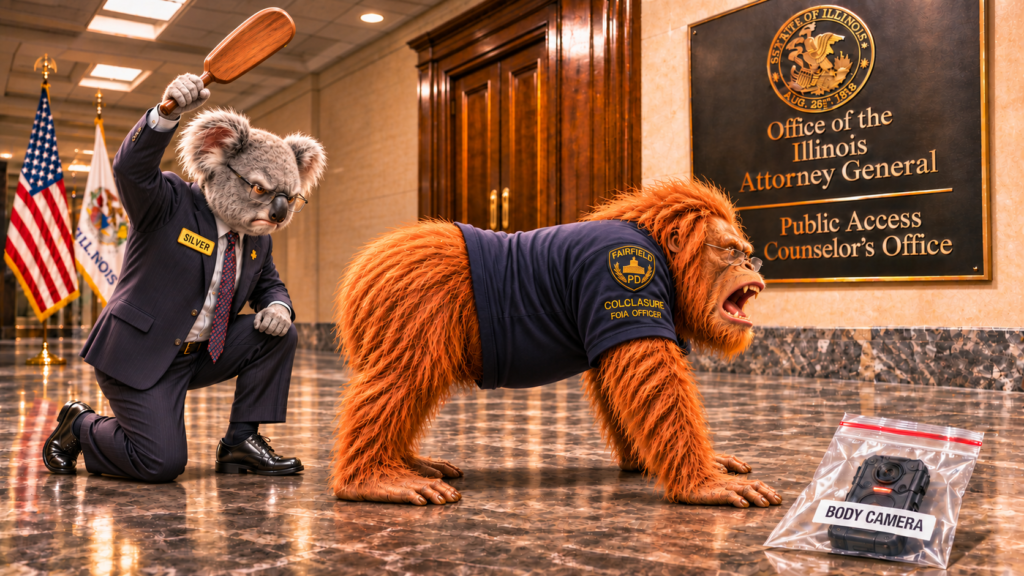
The illustration is AI-generated satire made at the editor’s direction; it is not a photograph or evidence of anything. “Defective Koker” is the editorial page’s coinage, not a finding of this newsroom. The Bureau’s statement that “further action is warranted” is screening language, not a finding of a violation. Quotes are from the recording, the denial letter, the incident report and the complaint as filed. The characterization of this as a practice rather than an accident is analysis and is identified as such.
Comments
Sign in with Google to comment. Your comment posts immediately and is reviewed afterwards. Your address is never published.