
Three Fires: Gaza, Hormuz, and the Strike on Aramco
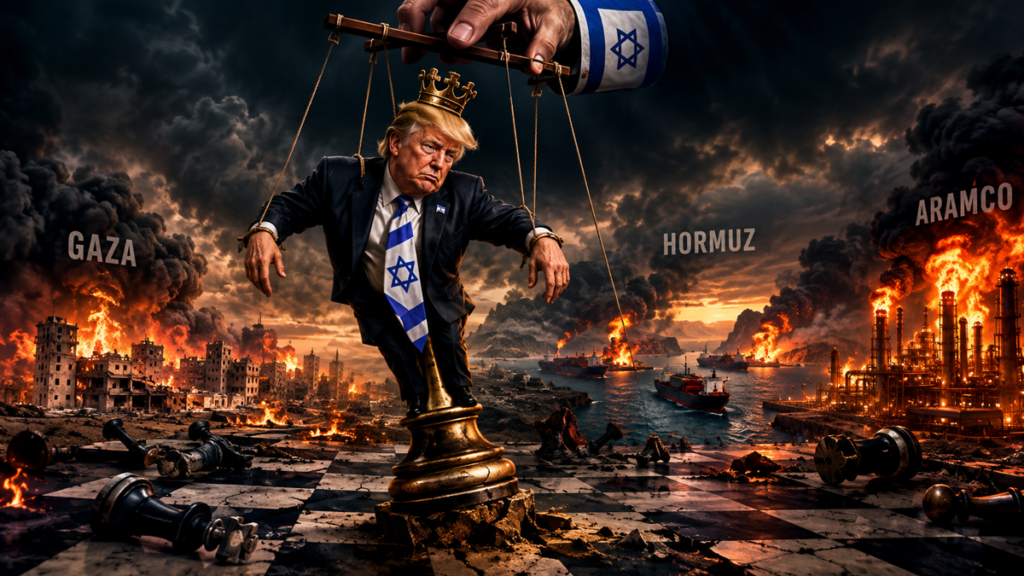
Three stories have dominated the international wire in the first half of this month, and all three sit in the same neighborhood of the world: Gaza a year into a ceasefire, the Strait of Hormuz, and Saudi Arabia’s oil infrastructure. Here is what is actually established in each one — and, where the accounts conflict, exactly who is saying what.
1. Gaza, a year into the truce, and still counting the dead
On Tuesday, an Israeli air strike hit a vehicle in the Tuffah neighborhood of Gaza City, killing one person and wounding several, according to emergency services reporting to Al Jazeera. In az-Zawayda, in central Gaza, a four-year-old boy, Osama Ahmed Abed, died of wounds from an attack three weeks earlier, the Palestinian news agency Wafa reported — bringing the count of Palestinians killed in Gaza since Oct. 7, 2023 to more than 74,382.
The frame matters more than the incidents. This is not a fresh war. The ceasefire reached in October 2025 — a year old this month — remains the governing document, and Israeli strikes inside Gaza have continued at or near a daily pace throughout it. At least 1,400 Palestinians have been killed in Israeli attacks since the truce began, and no Palestinian technocratic administration is in place.
The geography is the part that reads like a record entry rather than a battle report. Under the U.S.-backed 20-point plan, the “Yellow Line” marked where Israeli forces first pulled back, with further withdrawals to follow. Al Jazeera’s maps show nearly two-thirds of Gaza now under Israeli military control or subject to access restrictions, and Israeli forces having seized more territory rather than ceded it. Gaza’s Civil Defence agency says it is deeply concerned about repeated forced displacement near that line, reporting that “massive explosions” and “indiscriminate gunfire” have damaged hundreds of displaced people’s tents and weakened buildings hit earlier. More than 80 percent of Gaza’s buildings are destroyed or damaged.
In the occupied West Bank, Israeli raids in Ramallah and el-Bireh wounded a child with live ammunition and left several Palestinians suffering from tear gas, the Palestinian Ministry of Health said. Two journalists were injured — Palestine TV correspondent Khaled Mattawa by a sound bomb, Sky News Arabia correspondent Firas Lutfi by shrapnel — and forces raided the offices of several Palestinian non-governmental organizations and the courtyard of the Palestine Medical Complex. Prime Minister Benjamin Netanyahu said in a video that Israel is preparing for a scenario in which Palestinian Authority forces turn their guns on Israel, and that there will be no “Arab army west of the Jordan River.”
Contested or one-sided: casualty figures come from Gaza’s health and civil-defence authorities; the extent of territory under Israeli control is Al Jazeera’s mapping, not an Israeli figure; and the ceasefire’s anniversary was marked by the U.S.-backed Board of Peace with a statement crediting President Donald Trump’s leadership with ending “a war that had no end in sight.” Those are claims by parties to the conflict, and they are labeled as such.
2. Hormuz: the worst shipping attacks since the war began
The Strait of Hormuz is where about 20 percent of the world’s crude oil and liquefied natural gas normally passes — roughly 125 large commercial vessels a day before the U.S. and Israeli war on Iran began on Feb. 28. Iran effectively closed the strait in response, and the United States has maintained a naval blockade on Iran’s southern ports ever since.
Since then, the strait has become a shooting gallery with a contest attached to it. Iran’s navy announced it has deployed new operational units east of the strait and across the Sea of Oman and the Arabian Sea, after identifying a tanker that was damaged and caught fire, and said the units would keep “real time surveillance of enemy activities and maritime traffic.” Iran warned vessels not to switch off their transponders and told them to coordinate with Iranian armed forces for safe passage. An Iranian official told Reuters that Tehran began using different offensive tactics about ten days ago — changing both the type and the pace of attacks, with one stated goal being to influence next month’s U.S. midterm elections. That last point is the official’s claim about intent, not a fact established by anyone else.
The numbers are the strongest thing in the story, because two independent trackers count the same escalation. Kpler recorded 10 tankers struck in the strait between Sept. 28 and Oct. 4, plus another strike on Oct. 5. The UK Maritime Trade Operations center recorded 15 further attacks between Oct. 6 and Oct. 14, 11 of them in just four days, including a container ship and a tanker hit by unknown projectiles on Tuesday. The U.S. Navy-led Joint Maritime Information Center reported the threat to merchant shipping as “severe,” its second-highest level, citing continued attacks, attempted attacks and harassment by Iran’s Revolutionary Guard, including drone overflight, targeted surveillance and occasional VHF radio hailing of passing ships.
The war also runs through the oil price. Gulf flows through Hormuz, excluding Iran, had recovered to more than 81 percent of pre-war levels in September, and Middle East crude exports beat pre-war levels on 14 days that month. In the past week that reversed: Kpler counted only 2.9 million barrels passing through the waterway on Oct. 11 — the month’s lowest — against 20.8 million barrels on Oct. 8 and a pre-war daily average of 17.1 million. Brent crude futures rose 89 cents, or 0.8 percent, to $106.58 a barrel by early Wednesday, after closing at $105.69 on Tuesday.
Both sides are arguing about control of the waterway, in public. A U.S. military official told Reuters that after American forces destroyed much of Iran’s radar, the Revolutionary Guard began using unarmed spotters in small boats to identify targets, including U.S. naval vessels, and that U.S. forces confronted one such boat, told its occupants to abandon ship and destroyed it. U.S. Central Command rejected the Revolutionary Guard navy commander’s assertion that Tehran controls the strait: “IRGC’s navy commander has no navy. American forces and regional partners clearly control the Strait of Hormuz.” Iran’s security chief, Mohsen Rezaei, countered that U.S. Central Command, with help from the United Arab Emirates, is using smaller vessels to ferry oil to larger tankers, called that shuttle an explicit target, and said Iran has been striking five or six participating vessels nightly for weeks. Iran also says Washington accepted some of its seven conditions for reopening the strait, and that the response was insufficient.
The independent read, from Chris Featherstone, a political scientist at the University of York, is that the strait is under neither party’s control: Iran’s attacks are an attempt to show that Washington does not control it either. Anyone reading the two sides’ statements side by side should hold them that way — as statements by combatants about a waterway both say they own.
3. A missile hit Aramco’s headquarters
Overnight into Wednesday, an Iranian-backed Houthi strike hit the headquarters of Saudi Aramco in Dhahran, damaging the offices of the company’s chief executive and other top officials. Two regional officials, speaking anonymously because they were not authorized to discuss it, said the strike damaged the building’s top three floors and caused no casualties. The Houthis had warned in advance that they were targeting Dhahran with a ballistic missile, and Saudi Arabia’s energy ministry reported a limited fire at the building on Tuesday night. Aramco did not respond to a request for comment.
It is the latest in a week of attacks on high-profile Saudi targets. Riyadh’s civil defence authorities said debris from an intercepted strike injured one person, and the state news agency published images of a damaged building and a vehicle with a missile-like cylinder lodged in its hood. The Saudi-led coalition said it intercepted two Houthi drones, four cruise missiles and one ballistic missile aimed at Riyadh, a ballistic missile aimed at Dhahran, and a cruise missile aimed at al-Kharj. King Khalid International Airport in Riyadh has been hit repeatedly in the past week, with at least 18 people killed and more than 300 wounded — aviation analytics firm Cirium counted more than 3,000 scheduled flights canceled or listed as not operating across Saudi airports in that week.
The Houthis call the attacks retaliation for what they describe as treacherous Saudi aggression against Sanaa and other areas, as the kingdom backs Yemen’s internationally recognized government in an offensive launched about ten days earlier. The rebel-run health ministry reported two dead in Yemen on Tuesday and blamed the Saudis; the coalition struck an oil facility in Sanaa and another near the Ras Isa port in Hodeida province, where the Houthi-run ministry reported two killed. The International Committee of the Red Cross reports an “unprecedented surge” in combat casualties along Yemen’s front lines — particularly Marib, the Red Sea coast and the besieged city of Taiz, where the World Food Program says it can no longer reach more than 600,000 people who depend on aid. Schools in Taiz were ordered closed for a month, and residents describe fuel shortages and dwindling supplies.
The strategic problem underneath it is a shortage of interceptors: regional officials say Saudi Arabia, the world’s top purchaser of U.S. weapons, is running low, while trying to defend a territory about three times the size of Texas against an arsenal able to reach targets well over 1,000 miles away. President Trump has said he is evaluating whether the United States should join Saudi strikes against the Houthis. A senior Houthi official, Mohamed al-Bukhaiti, told the Associated Press that Oman has tried to bring both sides back to the table and that Russia and China have also tried through Iran — “We’re welcoming any mediation that leads to an end of the war and the blockade between Sanaa and Riyadh.”
Why a Wayne County newsroom runs a world desk
Because the mechanisms are the same ones we cover at home, and because the price of fuel and freight arrives on a county road eventually. The difference is distance: we did not witness any of this, and every fact above is attributed to the outlet or the party that said it. Where an account rests on anonymous officials or on a combatant’s own statement, this page says so rather than laundering it into a neutral voice.
Three threads to watch from here: whether the Gaza ceasefire’s next phase moves from statement to withdrawal; whether the Hormuz attacks force a negotiation or an American escalation; and whether the mediation the Houthis say they welcome produces anything before Yemen’s aid corridors close entirely.
Sourced to Al Jazeera’s reporting from Gaza City and on the Strait of Hormuz (Oct. 13–14), and to Associated Press reporting carried by PBS NewsHour on the Dhahran strike (Oct. 14), including Kpler, UKMTO, JMIC, Cirium, the ICRC and the World Food Program figures cited by those outlets.
Comments
Sign in with Google to comment. Your comment posts immediately and is reviewed afterwards. Your address is never published.