
The Piggy Bank: What America Buys Abroad, and What $23 Billion Does Not Buy at Home
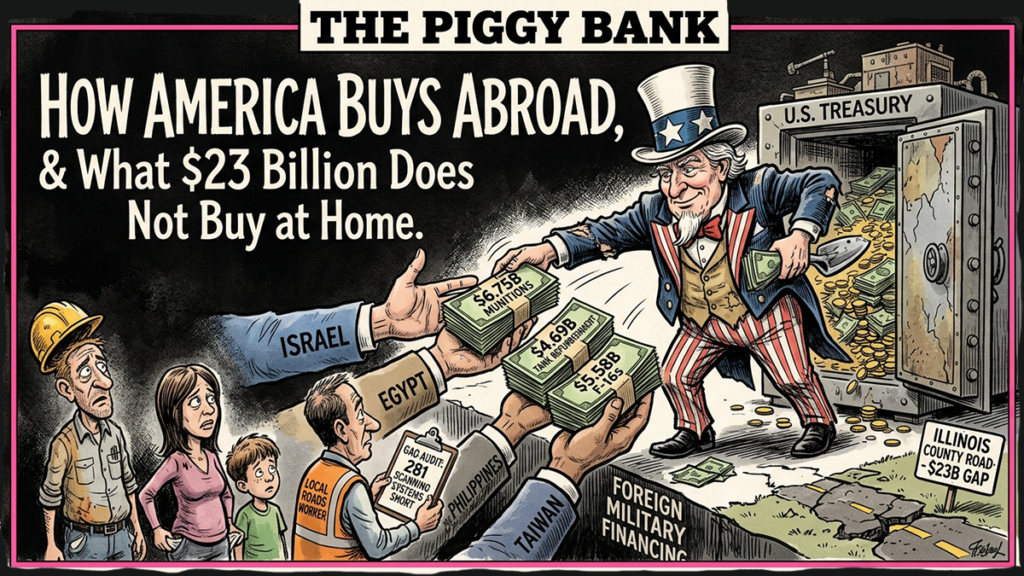
Four numbers circulate in every argument about American money going overseas, and they are four different things. The largest is not American spending at all. The smallest is the only one that is unambiguously a gift. And the one that matters most to a county road in southern Illinois is a procurement backlog that fits on a single page of a federal audit.
Here they are, in the order they should be read.
The $331 billion number, unpacked
The State Department’s fact sheet on FY2025 U.S. Arms Transfers and Defense Trade, published Mar. 16, 2026, records $331.18 billion in total arms-transfer sales and authorizations for the year. That figure gets quoted as though it were American aid. It is not.
It is the sum of two separate channels. Foreign Military Sales — government-to-government deals — totaled $104.38 billion. Direct Commercial Sales — licensed exports contracted privately — accounted for $226.8 billion in authorizations. And within the FMS total, most of the money belonged to the buyers: $75.90 billion of FMS activity was funded by allied and partner governments purchasing with their own funds.
That is the single most important sentence in any American First argument about the arms trade, and it cuts against the loudest version of the complaint. When Japan or Poland buys an American fighter, that is an American export, not an American subsidy — and DCS authorizations, the biggest line of all, are mostly private contracts that the United States did not pay for.
The State Department also records 16,098 open FMS cases with a value exceeding $934 billion. That is a cumulative book of undelivered orders, not spending, and treating it as money spent this year is the second most common error in this debate.
The part that is actually American money
Inside the FMS total, two lines are funded by the United States.
$17.92 billion was funded through Title 22 Foreign Military Financing — the program that gives allied governments money to buy American weapons. $10.56 billion was funded through Defense Department Building Partner Capacity accounts and certain State programs. Those two lines, about $28.5 billion together, are the American taxpayer’s share of the FY2025 arms-transfer picture. They are also the only honest figure to use when the question is what the United States gave away.
The year’s largest announced cases show where it went, though case values are notifications rather than a recipient ranking: Israel, $6.75 billion in munitions, guidance kits, fuzes and support; the Philippines, $5.58 billion for F-16 aircraft; and Egypt, in two notifications of $4.69 billion for Abrams tank refurbishment, support and equipment and $4.67 billion for a NASAMS air-defense system.
For Israel specifically, the standing commitment is the ten-year memorandum of understanding covering FY2019 through FY2028 and totaling $38 billion. Monster News found no verified replacement MOU in 2026.
What Congress waived
The clearest case for looking at process rather than totals is a sale that was never going to make a headline.
On Mar. 6, 2026, the State Department’s Transmittal #26-32 approved a possible Foreign Military Sale to Israel estimated at $151.8 million for 12,000 BLU-110A/B 1,000-pound bomb bodies and support services. The notice states that the Secretary of State determined an emergency existed and waived the usual congressional review under Section 36(b) of the Arms Export Control Act.
Section 36(b) is the statute that gives Congress its window to object to a major arms sale. Waiving it is lawful, it is not rare, and it is not a scandal by itself. What it means is that on $151.8 million of munitions, the review American law normally provides was removed by an executive determination — and the public record of that determination is a one-page notice with a transmittal number.
Separately, Reuters reported on Sept. 15, 2026 that the administration was planning a $2.8 billion munitions package. Monster News has not found an official notice establishing that package’s final approval or delivery, and this story does not treat the figure as settled.
The war that is not in the budget request
The same Reuters report of Sept. 15, 2026 cited Congressional Budget Office and Pentagon estimates putting the cost of the Iran war at $38 billion, with a forecast of roughly $3 billion a month going forward. Monster News could not obtain the underlying CBO or Defense Department document and does not present that figure as verified.
It matters anyway, because of what it is not: it is not in a budget request Congress voted on before the fighting started, it is not a line item anyone could look up during the debate, and it distinguishes between three things that should never be added together — the cost of operations already conducted, the cost of replacing munitions already fired, and the cost of borrowing to do both. A cost report is not an appropriation. A supplemental request is not an authorization. The FY2026 request for international affairs was $31.14 billion, according to the Congressional Research Service, and the cost of one year of one war is now being reported at more than the entire request it sits beside.
The appropriations, as they actually stand
Three documents matter, and none of them is what gets quoted.
Enacted. The Consolidated Appropriations Act, 2026 — H.R. 7148, Public Law 119-75, signed Feb. 3, 2026 — carries the National Security, Department of State and Related Programs appropriations and is the enacted basis for FY2026 foreign assistance. Nothing in it is a proposal.
Requested. The administration’s FY2026 request was $31.14 billion in new budget authority for State and foreign operations accounts, per CRS; a separate CRS summary described $19.20 billion for a narrower set of accounts. The two figures answer different questions and are often quoted against each other as if one were wrong.
Requested, next year. The FY2027 request, released Apr. 3, 2026, proposes a restructuring and consolidation of accounts including a concept called the “America First Opportunity Fund.” CRS identifies $24.55 billion in new budget authority for the covered accounts, 29.9 percent below FY2026 enacted — a CRS-reported figure Monster News could not confirm against the full report. A proposal is not an appropriation, and the account restructuring in particular is a proposal.
What $23 billion does not buy
On the American side of the ledger, the scale is smaller and the shortage is more concrete.
Customs and Border Protection’s FY2026 budget request was $23.0 billion with 69,874 positions and 67,964 full-time equivalents; its FY2027 request is about $22.9 billion in total budget authority, including $18.5 billion in net discretionary funding. Both are requests. FY2026 started under a continuing resolution that funded the Department of Homeland Security only through Feb. 13, 2026, and a separate DHS law followed; Monster News did not verify the enacted CBP line-item total.
What is documented in detail is the equipment gap, and it is a specific list. As of Dec. 2, 2025, CBP had deployed 405 large-scale non-intrusive inspection systems at air, sea and land ports of entry, with 38 more planned by the end of FY2026 and stated targets of scanning 40 percent of passenger vehicles and 70 percent of commercial vehicles at southwest land ports.
The Government Accountability Office reported on Jan. 22, 2026 that 52 of 153 planned large-scale systems at land ports were fully operational as of February 2025, that CBP estimated it needed 434 to meet its scanning goal, and that 281 had not yet been procured — including 62 for the southwest border. GAO also found that CBP’s southwest-border plan omitted passenger-vehicle scanning at nine crossings, three of them high-traffic locations that together handled nearly 40 percent of southwest-border passenger-vehicle traffic in FY2024.
That is a procurement list, not a philosophy. It has a quantity, a cost driver and a border crossing attached to each entry. And the systems that do exist pay for themselves in seizures: in FY2025, large-scale inspection systems scanned more than 17 million sea containers, rail cars and vehicles and produced 110,000 pounds of narcotics interdictions, about $2.2 million in unreported currency and 66 undeclared passengers. More than $1 billion from the One Big Beautiful Bill Act has been allocated for inspection systems, artificial intelligence and related capabilities, and the FY2026 request included $137 million for more.
The daily load those systems have to keep up with, in CBP’s own FY2025 figures: roughly 1,138,130 passengers and pedestrians, 43,227 truck, rail and sea containers, 262,013 incoming privately owned vehicles and $9.8 billion in imported products — every day, with the agency describing those as approximate daily averages rather than annual totals.
And the direction the seizures point is not in dispute. CBP testified on Jan. 22, 2026 that of 255,243 pounds of drugs seized at the southwest border in FY2025, 192,701 pounds — about 75 percent — were seized at land ports of entry, where the scanners and the officers are. That is a share of seized weight at one border, not a measure of what gets through and not a fentanyl-only figure. It is still the clearest public answer to where the contraband is being caught.
The American First question
Take the four numbers in order and the answer changes shape.
The $331 billion is mostly other countries buying American products, and using it as evidence of American generosity is a mistake that discredits the argument making it. The $28.5 billion in Foreign Military Financing and Building Partner Capacity is American money given to other governments to buy American weapons — a subsidy to allies and, incidentally, to the defense industrial base. The $151.8 million emergency sale was small on its own and notable for the review that was waived, not the value. And the $38 billion aid guarantee is a decade-long commitment that is already appropriated through FY2028, which means it cannot be reallocated by anyone who has not first decided to renegotiate it.
The border side of the ledger is smaller in dollars and, unusually, precise in shortfall. 281 scanners CBP says it needs and does not have, 62 of them designated for the southwest border. Nine crossings where passenger vehicles pass unscanned, three of which handle nearly 40 percent of the traffic. A record 21,471 Border Patrol agents against a stated goal of 25,000. And no published, current nationwide count of how many canine teams the agency has, or how many more it says it needs — the drug-sniffing dogs, which is precisely the capability that is not a weapons system, does not need a carrier group, and does not appear in the arms-transfer fact sheet at all.
None of that settles what the right number is. It does settle what the honest comparison looks like: a documented, itemized domestic shortfall against overseas commitments whose costs are partly unreported, partly waived from review, and partly other countries’ money. A reader who wants a smaller overseas footprint has to be able to say which line, whose money, and what replaces it. The documents above are where that argument starts.
What is not established
Monster News could not verify a completed FY2026 annual total for arms transfers, commercial sales or Foreign Military Financing; an FY2026 Foreign Military Financing total by recipient country; any official cost figure for the Caribbean deployment, the boat strikes, the Yemen strikes or the Iran naval blockade; an official cost comparison between overseas operations and CBP’s budget; a current nationwide CBP canine count or stated requirement; or a nationwide port-of-entry maintenance backlog figure. The $38 billion war cost is reported, not confirmed. The FY2026 CBP authority and the FY2027 figures are requests unless identified as enacted, and the FY2026 request and enacted levels for foreign operations differ in scope as well as amount.
What to watch
Whether the FY2027 restructuring — including the America First Opportunity Fund — survives contact with Congress, and what the covered accounts actually get. Whether the reported $2.8 billion munitions package produces an official notification and whether Congress is allowed its review window. Whether the 281 unprocured scanners and the nine unscanned crossing plans get funded in the next appropriations cycle, and whether CBP publishes a canine requirement. And whether anyone publishes a real cost for the 2026 operations before the money has to be replaced.
Sourced to the State Department’s “Fiscal Year 2025 U.S. Arms Transfers and Defense Trade” (Mar. 16, 2026) for the arms-transfer, FMS, DCS, Foreign Military Financing, Building Partner Capacity and open-case figures, and for the Israel, Philippines and Egypt notifications; State Department Transmittal #26-32 (Mar. 6, 2026) for the emergency sale, with Section 36(b) of the Arms Export Control Act; Congress.gov for H.R. 7148 / Public Law 119-75 (Feb. 3, 2026) and the Congressional Research Service products R48624 and R48956 for the FY2026 and FY2027 figures; the State Department’s FY2027 international affairs budget materials for the proposed account restructuring; CBP’s congressional testimony of Jan. 22, 2026 (Diane J. Sabatino, Office of Field Operations) for the scanner counts, scanning targets, port and personnel figures, the FY2025 seizure share and the inspection results; GAO-26-108767 (Jan. 22, 2026) for the land-port scanning numbers, the 434-system requirement and the nine omitted crossings; CBP’s “On a Typical Day in Fiscal Year 2025” for daily traffic volumes; CBP’s release of June 24, 2026 for Border Patrol staffing; the FY2026 and FY2027 CBP budget justifications as published by DHS; and Reuters (Sept. 15, 2026), cited in the text as reported rather than confirmed, for the $38 billion war cost and the $2.8 billion package.
Comments
Sign in with Google to comment. Your comment posts immediately and is reviewed afterwards. Your address is never published.