
Guns to the Caribbean, Scanners for the Border
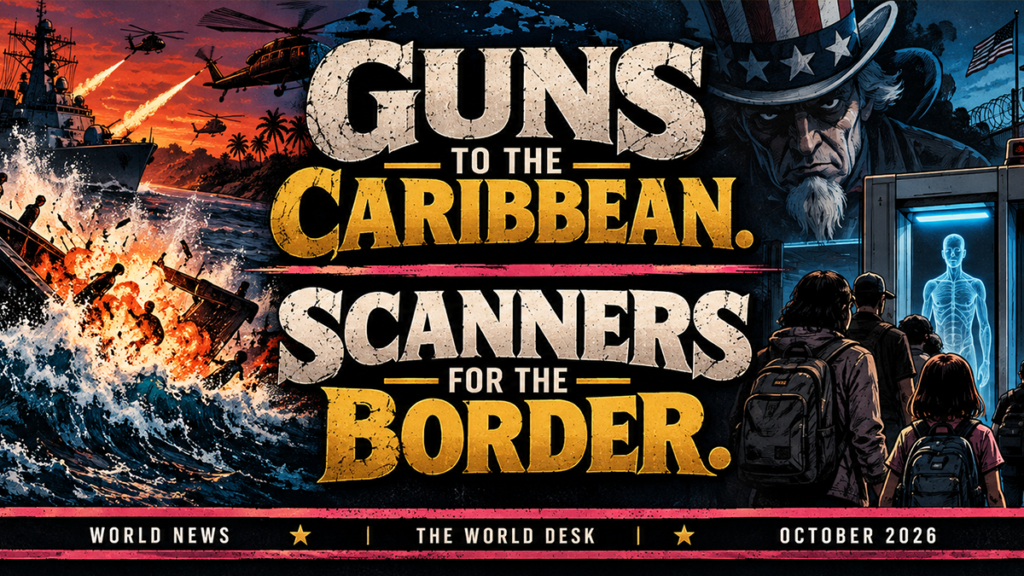
On Jan. 3, 2026, the United States struck targets across Venezuela and took its sitting president, Nicolás Maduro, and his wife, Cilia Flores, out of the country and into American custody. Since Sept. 2, 2025, the same campaign has struck 71 boats in the Caribbean and the eastern Pacific, killing 238 people, by the most complete public count available. On Oct. 15, Maduro and Flores stood in a federal courtroom in New York and pleaded not guilty.
All of that is being done under a legal opinion the American public still cannot read. On Sept. 30, 2026, a federal judge in the Southern District of New York ordered the government to hand over the Justice Department’s Office of Legal Counsel memorandum — the document that is said to supply the authority for killing people on boats — for the court to read privately, and to identify every person who has had access to it since it was written in September 2025.
There is a version of this story that is only about the boats. That version is incomplete, and the record makes the stronger case for the operation than the boats ever did: American citizens were tortured in Venezuelan custody, and the people accused of ordering it are now in an American dock. Both halves belong in the same lede, because both come out of the same operation, and because the bill for the half that is not a prosecution is still being settled.
The count, and who is counting
There is no official running total. The Defense Department files quarterly reports to Congress on the strikes; Monster News was unable to obtain the two most recent reports and does not quote figures from them. What exists in public is a campaign announced strike by strike on U.S. Southern Command’s own social media accounts, usually with video, and outside monitors who count those announcements.
Just Security, in a timeline published Oct. 4, 2026, puts the campaign at 71 strikes; 238 killed, including 23 missing or presumed dead; and three known survivors. WOLA, the Washington Office on Latin America, reported on July 24, 2026 that 221 people had been killed in 63 attacks announced since Sept. 2, 2025. Those are counts of the government’s own releases, compiled by two organizations with open positions on the campaign; the government has not published a matching tally.
The language in the announcements is part of the record too. SOUTHCOM describes striking a “go-fast vessel operating along established narco-trafficking routes” and says “confirmed intelligence revealed the vessel’s active involvement in narco-trafficking.” Earlier strikes were announced as vessels “operated by Designated Terrorist Organizations.” The strikes were executed “at the direction of” SOUTHCOM Commander Gen. Francis L. Donovan, first by Joint Task Force Southern Spear and, from Aug. 23, 2026, by Joint Task Force Western Hemisphere.
What those announcements also show is what happens after a hit. On June 21, 2026, the 66th strike killed two people and left six survivors; Southern Command said it immediately notified the Coast Guard to activate search and rescue. All six are now counted as missing or presumed dead. On June 16, a strike left two survivors and the Coast Guard suspended the search a day later. Three people in total have survived across 71 strikes.
The opinion nobody has read
The legal basis has a date and a filing number, and that is most of what is publicly known about it. The ACLU and the Center for Constitutional Rights filed a Freedom of Information Act complaint for the memo in December 2025. On Sept. 30, 2026, the judge ordered it produced for in-camera review, rejected the administration’s claims of deliberative process privilege and attorney-client privilege, and said the existing record did not let the court resolve whether the presidential communications privilege had been waived — ordering the government to file information enabling that decision.
That order is a ruling about disclosure. It is not a ruling that the strikes are lawful, and it is not a ruling that they are unlawful. What it establishes is narrower and blunter: nearly a year into a lethal campaign, the government’s own legal reasoning has not been tested in public, and a court has now decided it will read it in private.
What the operation produced — and the American case for it
The strongest argument for the Venezuela operation is not about boats or oil. It is in the Justice Department’s own indictment, unsealed Oct. 8, 2026. A superseding indictment charged Maduro, 63, and Flores, 69, with participating in a narcoterrorism conspiracy (20-year mandatory minimum, up to life), conspiring to commit torture (up to 20 years), conspiring to import cocaine into the United States (10-year mandatory minimum, up to life), and two counts involving machine guns and destructive devices (30-year mandatory minimum on one, up to life on the other).
The torture count has an American victim at its center, in the department’s own words. FBI Director Kash Patel: “As alleged in the indictment, the Maduro regime subjected American citizens to torture while held in custody of the Venezuelan government — including drugs, electric shock, sexual assault, and more.” The release describes one American detained in Venezuela and subjected to, among other things, deprivation of food and water, simulated drowning, repeated beatings, electric shock and forced injections. Attorney General Todd Blanche said the additional charges reflected the administration’s “dedication to delivering justice for the victims of torture, narcoterrorism, and organized crime.” The Southern District of New York’s U.S. Attorney, Jamie McDonald, described a two-decade conspiracy that included “the torture of multiple United States citizens.”
The indictment is an allegation. The Justice Department’s own release says so in its closing line: all defendants are presumed innocent until proven guilty beyond a reasonable doubt. On Oct. 15, 2026, both pleaded not guilty in New York.
That is a genuine American interest. It is also the one part of this story that did not need 71 boat strikes to happen, and the part that will be decided in a courtroom where a defendant can answer the evidence.
And then there is the oil
An operation to arrest a man accused of flooding the United States with narcotics is one thing. What has been built on top of it is a second thing, and it is on the record in the President’s own words.
On Jan. 6, 2026, President Donald Trump said the United States would take 30 to 50 million barrels of sanctioned Venezuelan oil, sold at market price, with the proceeds, in his words, “controlled by me, as President of the United States of America, to ensure it is used to benefit the people of Venezuela and the United States.” Venezuela’s state oil company confirmed the next day that it was negotiating to sell crude to the United States.
On Jan. 9, the President met about twenty oil industry representatives — Chevron, ConocoPhillips and ExxonMobil among them — to discuss a plan for companies to invest at least $100 billion in rebuilding Venezuela’s oil infrastructure. He told reporters afterward that a “deal” had been formed. Exxon’s chief executive said he was ready to put a team on the ground with security guarantees but called Venezuela “uninvestable” under the legal and commercial frameworks then in place. Treasury Secretary Scott Bessent said the administration would likely lift more sanctions on Venezuelan oil, would take up $5 billion of Venezuela’s frozen assets with the IMF and World Bank, and suggested the Export-Import Bank could guarantee financing. Energy Secretary Chris Wright put the purpose plainly: “We need to have that leverage and that control of those oil sales to drive the changes that simply must happen in Venezuela.”
The enforcement side ran on tankers. Five Venezuela-linked tankers were intercepted from the start of December 2025, including the Russian-flagged Marinera, also known as the Bella 1, taken in the North Atlantic after a roughly two-week pursuit under a federal court warrant, and the “stateless” M/T Sophia. Russia’s transport ministry objected that no state may use force against another state’s duly registered vessels under the law of the sea; China’s foreign ministry called the oil seizure “bullying” that “seriously breaches international law.” According to New York Times reporting, U.S. authorities boarded the tanker Olina without a court-issued warrant. The State Department issued a “Do Not Travel; Depart Immediately” alert for Venezuela on Jan. 10.
None of that is illegal by American law as the administration reads it. It is, however, a resource arrangement between two sovereign states that no American statute specifically authorized, resting on the same claimed authority as the strikes — which is the authority still sealed in a memo the court has now read and the public has not.
Congress was asked twice. It declined twice.
Whatever authority the President is using, it is not a new use-of-force authorization from Congress.
On Jan. 8, 2026, the Senate voted 52–47 to advance a joint resolution under the War Powers Resolution stating that the use of military force by U.S. armed forces “within or against Venezuela constitutes the introduction of United States Armed Forces into hostilities.” Republicans Rand Paul, Lisa Murkowski, Todd Young, Susan Collins and Josh Hawley voted with Democrats to advance it. The President called the resolution unconstitutional and said the Republicans who supported it “should be ashamed.” On Jan. 14, the measure was defeated on a 50–50 tie, with Vice President J.D. Vance breaking it. Hawley and Young changed their votes.
In the House, Representatives Jim McGovern and Thomas Massie introduced a war powers resolution on Jan. 7 directing the President to remove U.S. armed forces from Venezuela unless authorized by a declaration of war or a specific statutory authorization. On Jan. 22, it failed on a 215–215 tie, with two Republicans joining Democrats to support it.
The House also tried to find out what the plan was. On Jan. 7, Secretary of State Marco Rubio and Defense Secretary Pete Hegseth briefed lawmakers — the Chairman of the Joint Chiefs, Gen. Dan Caine, CIA Director John Ratcliffe and Attorney General Pam Bondi were present — and Rubio reportedly laid out a three-phase plan involving stabilizing and rebuilding the country, taking and selling its oil, and installing a new government. Lawmakers who attended said Hegseth did not clarify how long the military deployment would last. A group of Democratic senators wrote to American oil executives asking them to disclose meetings with administration officials about Venezuelan oil, and asking “the extent to which U.S. oil and gas companies such as yours had either advance knowledge of or the ability to shape American foreign policy decisions.”
The American who did not come home
On Feb. 7, 2026, Lance Cpl. Chukwuemeka E. Oforah, 21, fell from the USS Iwo Jima while assisting Operation Southern Spear and was lost at sea. He was pronounced dead on Feb. 10, the first known American casualty of the operation. The military says his death remains under investigation.
Meanwhile, at the line this is all supposed to protect
If the point of the campaign is fewer drugs in American communities, the documented American bottleneck is not offshore, and it is measurable.
Customs and Border Protection testified to the House Homeland Security Committee on Jan. 22, 2026 that of 255,243 pounds of drugs seized at the southwest border in FY2025, 192,701 pounds — about 75 percent — were seized at land ports of entry, not between them. That is CBP’s own accounting, and it is a share of seized weight at one border, not a measurement of everything that gets through and not a fentanyl-only figure. It does say where the seizures are happening.
What CBP says it lacks is equipment. As of Dec. 2, 2025, it had deployed 405 large-scale non-intrusive inspection systems — the drive-through scanners — at air, sea and land ports, and planned 38 more by the end of FY2026, with scanning targets of 40 percent of passenger vehicles and 70 percent of commercial vehicles at southwest land ports.
The Government Accountability Office reported on the same day that 52 of 153 planned large-scale systems at land ports were fully operational as of February 2025, that CBP estimated it would need 434 to reach its scanning goal, and that 281 had not yet been procured — 62 of them for the southwest border. GAO also found that CBP’s southwest-border plan omitted passenger-vehicle scanning at nine crossings, including three high-traffic locations that together accounted for nearly 40 percent of southwest-border passenger-vehicle traffic in FY2024.
The scanners CBP does have work. In FY2025, large-scale systems scanned more than 17 million sea containers, rail cars and vehicles, producing 110,000 pounds of narcotics interdictions, about $2.2 million in unreported currency and 66 undeclared passengers. More than $1 billion from the One Big Beautiful Bill Act was allocated for inspection systems, artificial intelligence and related capabilities, and the FY2026 request included $137 million for more. CBP reported in May 2026 that it had seized more than 100 million “lethal doses” of fentanyl along the southwest border in FY2026 to that point — a figure that depends on CBP’s own conversion assumptions about potency and weight, and should be read as an agency public-affairs measure rather than a count of doses or people.
On the officer and canine side, the numbers are thinner. CBP announced a record 21,471 Border Patrol agents on June 24, 2026, with Border Patrol Chief Rosario “Pete” Vasquez working toward 25,000. GAO reported on June 30, 2026 that on the northern border, agents assigned and working in sectors fell about 6 percent from FY2019 through FY2024 even as authorized numbers rose. One Big Beautiful Bill Act funding is projected to support hiring 5,000 CBP officers, 3,000 Border Patrol agents and 200 Air and Marine Operations agents. On canine teams — the drug-sniffing dogs — CBP’s testimony describes them as part of a layered approach but does not quantify how many it has or how many more it needs, and Monster News could not find a current nationwide figure or requirement.
The American First question
Put the two halves side by side, because both are on the same ledger.
The operation produced an American courtroom, an American indictment and American victims — citizens tortured in Venezuelan custody, whose accused torturers are now answering charges in New York, presumed innocent, with counsel, in front of a judge. Nothing else in the last decade of Venezuela policy produced that. Anyone arguing that the United States should never have acted has to account for it.
The same operation also produced 238 deaths at sea under an opinion still sealed from the public, three survivors out of 71 strikes, two war powers votes that failed on tie votes, one American lost off the deck of a ship, a $100 billion oil rebuild plan announced as a deal before the companies called the country uninvestable, and 30 to 50 million barrels of another country’s oil whose proceeds the President said he controls. It produced all of that without Congress ever passing a new authorization for it. When the money and the authority are both being improvised in public, the appropriate question is not whether the targets deserved it. It is who authorized it, whose resources are being committed, and what the American share of the bill is.
And on the one metric the domestic argument actually turns on — how much of this reaches American streets, and where — the answer that CBP and GAO have both put in writing is that the weight comes through the ports, and the ports are short 281 scanners the government itself says it needs. That is not an argument about the Caribbean. It is an argument about which side of the ledger gets funded first, and it is a question Congress can answer without a war powers resolution.
What is not established
Monster News could not verify an official cost figure for the boat strikes, the Venezuela operation or the Caribbean deployment, or any official comparison between those costs and CBP’s operating budget. No court has ruled the strikes lawful or unlawful. The two most recent Defense Department quarterly reports to Congress were not obtainable for this story and no figures from them are used here. There is no verified nationwide count of CBP canine teams or of how many more are needed. The CBP and GAO scanner numbers describe different dates and different system scopes and should not be treated as a single inventory.
What to watch
The court’s ruling on the OLC memo, which is the authority behind every strike and every seizure described above. The next Defense Department quarterly report to Congress, and whether its numbers match the outside tallies. Whether the Maduro trial proceeds and what the evidence shows about the American victims. Whether the 281 unprocured scanners and the unmet canine requirement appear in the next appropriations bill. And whether Congress ever votes a specific authorization for a campaign it has now twice declined to stop.
Sourced to Just Security’s “Timeline of Boat Strikes and Related Actions” (Oct. 4, 2026) for the strike count, the strike announcements quoted and the Sept. 30 court order; WOLA’s report of July 24, 2026 for the strike and casualty count of that date; the Department of Justice Office of Public Affairs release of Oct. 8, 2026, “Nicolás Maduro Moros and Cilia Adela Flores de Maduro Charged with Torture” (release 26-1160) for the charges, the quoted officials and the presumption-of-innocence statement; Reuters and the BBC (Oct. 15, 2026) on the not-guilty pleas; the Congressional Research Service product IN12618, the Department of War news release of Jan. 3, 2026, CNN and the Brookings Institution on the capture operation, and ABC News for Gen. Caine’s figure of more than 150 U.S. aircraft; CBP’s congressional testimony of Jan. 22, 2026 (Diane J. Sabatino, Office of Field Operations) for the seizure, scanner, port and personnel figures; GAO-26-108767 (Jan. 22, 2026) on land-port vehicle scanning and GAO-26-109195 (June 30, 2026) on northern-border staffing; CBP’s release of June 24, 2026 on Border Patrol staffing and of May 15, 2026 on fentanyl seizures. Dates, figures and quotes from the Just Security timeline concerning the Venezuela operation, the oil arrangement and the congressional votes are attributed there to primary documents, social media posts and other outlets’ reporting; where this story labels a figure as reported rather than confirmed, that is deliberate.
Comments
Sign in with Google to comment. Your comment posts immediately and is reviewed afterwards. Your address is never published.