
Foreign Money in a Midterm Year: What Is Documented, What Is Legal, and What Nobody Has Closed
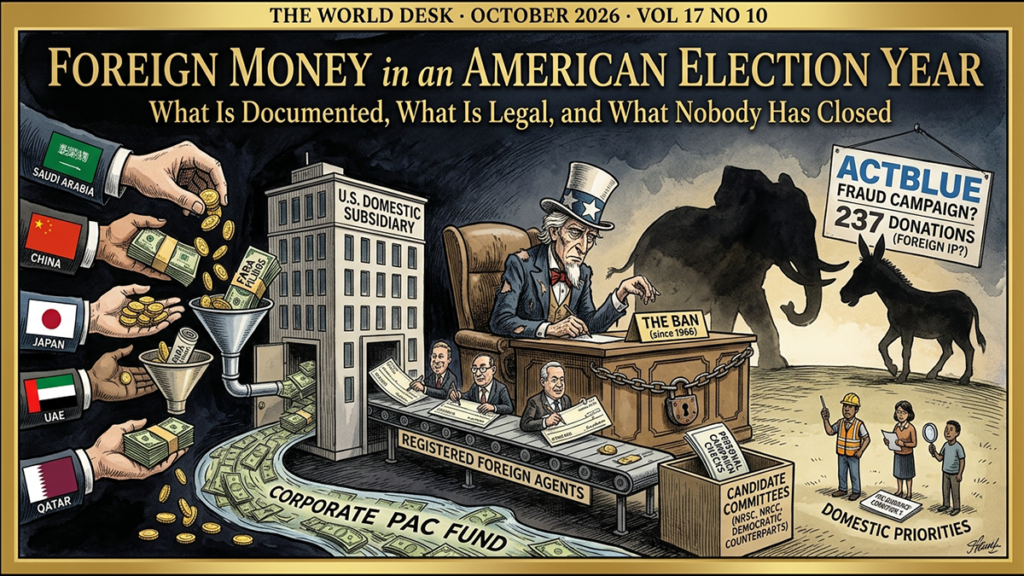
Federal law has banned foreign money from American elections since 1966. What has grown up around that ban is a disclosure regime for foreign influence that is now measured in the billions, a set of legal routes that let foreign-owned companies in through a side door, and a stream of personal campaign checks written by people who are paid to represent foreign governments and are perfectly entitled to write them.
Three weeks before a midterm election, here is what the record actually supports about foreign money in American politics — separated from what is alleged, what is legal, and what is simply unknown.
The statute, and where it stops
The prohibition is 52 U.S.C. § 30121, formerly 2 U.S.C. § 441e, implemented in part by 11 C.F.R. § 110.20. It bars a foreign national from making a contribution, donation or expenditure — including an independent expenditure — or any election-related disbursement in connection with a federal, state or local election, directly or indirectly. It also bars a foreign national from taking part in decisions about election-related activity, and bars anyone from knowingly providing substantial assistance, including acting as a conduit. The definition of foreign national covers a person who is neither a U.S. citizen nor a lawful permanent resident, and a foreign principal as defined in 22 U.S.C. § 611(b). A green-card holder is not a foreign national for this purpose and may give.
That is a real ban, and it is the reason the rest of this story is about disclosure and structure rather than about envelopes of cash. It is also narrower than most campaign-trail talk implies. It does not ban foreign governments from spending money in the United States. It bans them from spending it on elections, and requires them to report spending on everything else.
The subsidiary route
The most-used legal path runs through American subsidiaries of foreign companies, and the Federal Election Commission’s guidance is more careful than either side of the argument usually admits.
A U.S. domestic subsidiary of a foreign corporation can establish and administer a federal separate segregated fund — a corporate PAC — if three conditions hold. It must be a distinct entity incorporated in a U.S. state with its principal place of business in the United States. The foreign parent must not finance election-related contributions or expenditures, directly or indirectly, and the subsidiary must be able to show through a reasonable accounting method that it has sufficient funds from its own U.S. operations. And U.S. citizens or permanent residents must make all the decisions about administering the fund. A foreign corporation cannot establish or administer such a fund itself.
For partnerships and LLCs, the rule is attribution: no part of a contribution may be attributed to a foreign-national member or partner, and a foreign-national member may not take part, directly or indirectly, in decisions about U.S. election contributions. That is a fact question about who funds and who controls the entity, not a safe harbor.
Monster News found no verified 2025 or 2026 FEC decision or deadlocked vote that loosened the foreign-national ban or created a new subsidiary exception. Older deadlocks over domestic subsidiaries are from 2016. Anyone describing a brand-new foreign-money loophole at the FEC should be asked for the document.
What the foreign governments spent
Foreign governments do not hide their American spending. They register it. Under the Foreign Agents Registration Act, agents of foreign principals file with the Justice Department, and OpenSecrets’ Foreign Lobby Watch dashboard totals those filings.
Its figure for all registered foreign spending since 2016 is $6,779,741,207. For 2025, the largest country totals were Saudi Arabia at $91,995,847, China at $83,962,297, Japan at $76,067,944, Turkey at $55,495,976 and the United Arab Emirates at $21,106,317. Among individual principals, the largest 2025 figures listed are the Government of Saudi Arabia at $74,127,721, the Government of China at $71,391,998, the Government of the Bahamas at $35,564,314 and the Government of the United Arab Emirates at $12,461,744. For Qatar, the dashboard shows $6,228,989 in government spending and $3,901,205 in non-government spending in 2025, including $5,430,991 for the Government of Qatar, $2,797,200 for Qatar Museums, $311,536 for the Qatar Foundation and $42,000 for the Film Committee Qatar.
Two limits on those numbers matter more than the numbers. FARA registration is disclosure of payments to agents, not proof that any member of Congress changed a vote, and the filings cover activity including trade and tourism promotion, so the totals are not a lobbying-only figure. And they are payments, not influence — a distinction the dashboard itself makes. What the figure does establish is the scale of the permanent Washington operation that foreign governments are willing to pay for, in public, in an election year.
The checks written by registered foreign agents
A separate and more specific category is donations to American campaigns by people who are registered as foreign agents. Those donations are legal. The money is the agent’s own, not the foreign principal’s.
The Washington Examiner reported on Feb. 20, 2026, after reviewing Justice Department FARA records, that individuals registered as foreign agents had contributed “well over $7 million” to state and federal elections since January 2025. Its examples: Andrew King, founder of Neale Creek, contributed nearly $60,000 in 2025 while his firm was paid roughly $50,000 a month to represent Qatar; Jim Moran and Austin Durrer of Moran Global Strategies each gave about $50,000 to political committees in 2025, while their firm received $55,000 a month for representing Qatar. The National Republican Senatorial Committee and National Republican Congressional Committee together received $357,932 from foreign agents in 2025, the report said, against $338,500 for their Democratic counterparts since January 2025. Senator Mark Warner received more than $100,000 from foreign agents in 2025; committees linked to Senator Ted Cruz received just over $80,000.
What that establishes is narrower than the headline: registered representatives of foreign governments, who are required to disclose that representation, are also campaign donors, and their donations are reported. It does not establish that a foreign government directed a contribution, and the report notes that some agents also represented domestic clients. A lobbyist’s own check is not foreign money unless somebody shows the foreign principal financed or directed it — which is exactly the showing the law requires.
What the White House says it is looking at
On April 24, 2025, President Donald Trump issued a memorandum directing Attorney General Pam Bondi, in consultation with Treasury Secretary Scott Bessent, to investigate alleged “straw” and foreign contributions made through online fundraising platforms. It cited a House investigation reporting that ActBlue had detected at least 22 “significant fraud campaigns,” nearly half with a foreign nexus, and that during a 30-day period of the 2024 campaign the platform had detected 237 donations from foreign IP addresses using prepaid cards. It directed a report back to the President within 180 days.
Those are figures cited in a presidential memorandum, and a memorandum is not a finding. A foreign IP address is not proof of a foreign donor, and a detected fraud campaign is not a conviction. The memorandum ordered an investigation; Monster News could not find a published report answering it.
The other foreign hand: influence without a check
Cash is the narrowest way to affect an election, and the least interesting one.
The Brennan Center for Justice concluded on July 2, 2026 that China, Iran and Russia are likely to attempt to influence the midterms, and argued that federal capacity to detect and counter election threats has receded. Among the activity it describes: a Chinese government effort paying people to pose as Western journalists or influencers, per a March report from the European Council on Foreign Relations; Russia’s Social Design Agency hacking Bluesky users to spread false stories; and Iranian propaganda operations using fake news sites and AI-created influencers, including amplification of a fake video of a U.S. fighter jet crash in February. The Center also warns that claims of foreign interference can be used domestically without substantiation — a caution worth keeping for the next three weeks.
Those are allegations about foreign activity, at least some of it outside the United States, not proof of anything that changed an American vote. Monster News could not verify a single 2026 American campaign ad traced to a foreign government or foreign national, and this story does not claim one.
The bill the House passed, and what it does not do
On July 13, 2026, the House passed H.R. 3535, the Stop Foreign Funds in Elections Act, by voice vote. Sponsored by Representative Brian Fitzpatrick of Pennsylvania with Representative Jared Golden of Maine and others, it would amend 52 U.S.C. § 30121(a)(1)(A) to expressly include state and local ballot initiatives, referenda and recall elections in the foreign-national prohibition. It was received in the Senate on July 14 and referred to the Senate Rules and Administration Committee. It has not been enacted.
That bill closes a real gap — foreign money aimed at a ballot question rather than a candidate — and it does nothing at all about the parts of this story that involve the largest sums. It does not touch FARA spending, does not touch the domestic-subsidiary route, and does not change the rules for contributions to federal candidates, because those are already prohibited. A separate measure, H.R. 9874, the “Get Foreign Money Out of United States Elections Act,” was introduced in July 2026; Monster News has not verified its text or current status and does not describe it.
The American First question
Read the record without the adjectives, and the shape of the problem is not a single loophole. It is four separate things running at once: $6.8 billion in disclosed foreign-agent spending since 2016, with Saudi Arabia and China alone accounting for $176 million in one year; more than $7 million in campaign checks written by registered foreign agents in less than two years; a subsidiary structure whose legality depends on an accounting question the FEC has never had to litigate at scale; and a disclosure law, FARA, that reports payments instead of restricting them.
If the concern is that foreign governments are buying American policy, the honest answer is that most of what they buy is access, and they buy it legally, through registered agents, in filings anyone can read. If the concern is that American elections are being financed from abroad, the law already prohibits it — and the enforcement question is whether anyone is proving cases and publishing the results, which is what the April 2025 memorandum ordered and what the public has not seen.
The one thing the record does not support is treating a lobbyist’s personal contribution, or a trade-promotion filing, as if it were a foreign government handing cash to a candidate. That distinction is not a technicality. It is the difference between a real accountability story and a rumor, and it is the difference between a law that can be enforced and one that gets argued about instead.
What is not established
Monster News could not verify a comprehensive 2026 FARA country-by-country total, a 2025–26 FEC decision loosening the foreign-national ban, a 2026 U.S. midterm advertisement traced to a foreign government or national, or any published report answering the April 2025 memorandum. The ActBlue figures are figures cited in the President’s memorandum, not adjudicated findings. The Washington Examiner’s totals are that outlet’s review of FARA records, not a government audit. The OpenSecrets totals cover activity broader than lobbying.
What to watch
Whether the Senate moves on H.R. 3535 before the election, or leaves ballot-measure spending as the one door the statute does not close. Whether the Justice Department’s investigation under the April 2025 memorandum produces charges, a report or nothing. Whether the FEC takes up the subsidiary question in a cycle where foreign-owned companies are spending heavily. And whether any 2026 interference claim is accompanied by evidence — because this is the season when unsupported ones get made, in both directions.
Sourced to 52 U.S.C. § 30121 and 11 C.F.R. § 110.20, and the Federal Election Commission’s guidance pages on foreign nationals (accessed Oct. 16, 2026); OpenSecrets’ Foreign Lobby Watch dashboard, 2025 data, and its Qatar country page; the Washington Examiner’s examination of FARA filings, “Foreign agents pump cash into campaigns ahead of 2026 elections” (Feb. 20, 2026); the White House memorandum “Investigation into Unlawful ‘Straw Donor’ and Foreign Contributions in American Elections” (Apr. 24, 2025); the Brennan Center for Justice, “Threat of Foreign Influence on U.S. Elections Remain as Federal Defenses Recede” (July 2, 2026); and Congress.gov’s record for H.R. 3535 (119th Congress). Allegations, filings and adjudicated findings are labeled where they appear; a number is never presented as proof of influence.
Comments
Sign in with Google to comment. Your comment posts immediately and is reviewed afterwards. Your address is never published.