
The Wheelchair-License Alarm in Cortland
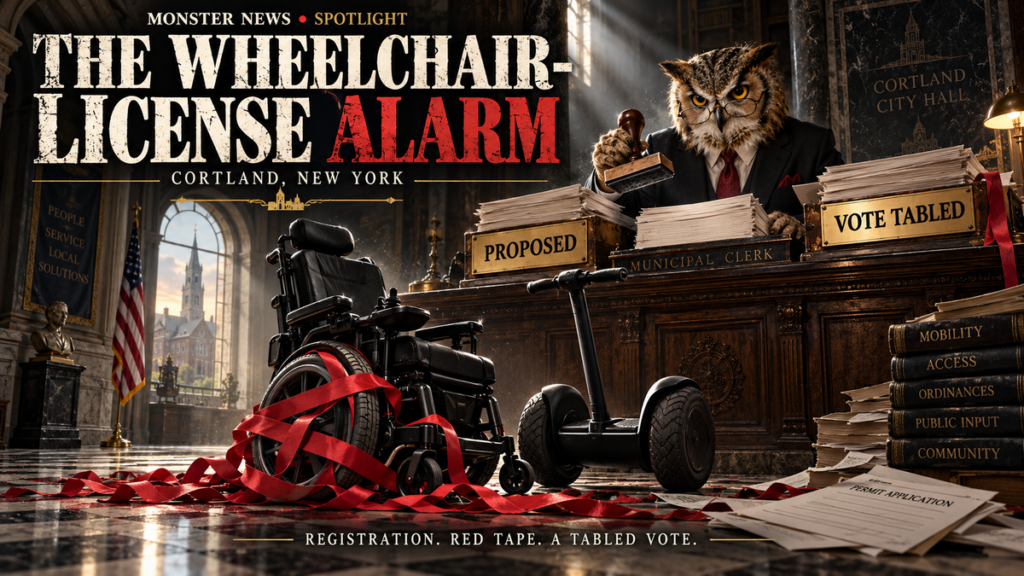
Cortland proposed registering bikes, scooters and a defined class of mobility devices. The council tabled the law—and the record is more complicated than the viral claim.
Monster News Spotlight — 23 October 2026
A claim that Cortland, New York, was about to make people license their wheelchairs sounds like a bad joke. It grew out of a real proposal—but the details matter.
In August 2025, the City of Cortland proposed replacing its bicycle code with rules covering bicycles, e-bikes, e-scooters and “electric personal assistive mobility devices,” or EPAMDs. The draft would have required city residents to register those devices before using them in public, submit identifying information and a serial number, and attach a city-issued decal. Fees could be set later by council resolution. The proposal also allowed unregistered devices to be impounded, subject to an express exception for EPAMDs unless abandoned, and imposed fines for violations.
That language was broad enough to raise a legitimate accessibility question. But “wheelchair” was not the proposal’s defined category. It borrowed New York’s narrow statutory definition of an EPAMD: a self-balancing, two-wheeled device—think a Segway-style transporter—not every powered wheelchair or mobility scooter. More importantly, at the August 19 public hearing, Cortland’s corporation counsel said devices used by people with mobility disabilities, including electric wheelchairs and mobility scooters, were excluded and would not need registration or face the proposed operating restrictions.
That clarification did not erase the drafting concern. A resident using a less conventional device, such as a Segway for a disability, asked the city to make the exemption explicit. Speakers also objected to the proposal’s fees, registration database, enforcement burden and effect on people who rely on low-cost transportation.
The council did not pass the proposal that night. The official minutes record a motion to table it. That is a postponed vote, not proof that the council formally repealed or permanently withdrew the proposal. The version currently listed in the city code is the older bicycle chapter; the public record we located does not show the 2025 draft becoming law.
What about Young Americans for Liberty?
You may have heard that Young Americans for Liberty got involved and the city dropped the plan. We could not verify that causal link in the sources we reviewed. The council minutes document residents’ objections and the decision to table the proposal, but do not attribute that outcome to YAL. Until a reliable source or primary record establishes the organization’s role—and shows what happened after the tabling—we should not state that as fact.
There is a second overstatement to avoid: the draft did not explicitly announce jail time for wheelchair use. It classified violations as violations of the city code and set fines by council resolution. New York law generally allows a court to impose up to 15 days’ imprisonment for a “violation,” but the draft itself specified a fine and did not spell out a jail term. The stronger, supportable criticism is that the proposal contemplated mandatory registration, possible fees, impoundment and penalties for covered devices, while its disability protections needed to be clearer on the page.
The lesson in the paperwork
The alarm was not invented from nothing: EPAMDs appeared in the draft, and the proposed registration language applied to them. But “Cortland required wheelchair users to buy licenses or go to jail” collapses a disputed draft, a legal definition, the city attorney’s public clarification and a tabled vote into one claim—and goes beyond what the record establishes.
The fair account is still worth spotlighting. A city proposed a registration-and-enforcement scheme broad enough to worry disabled residents and other riders. People challenged it at a public hearing. The city’s lawyer said mobility devices used by people with disabilities were exempt, but a resident asked for that protection to be written more explicitly. The council tabled the proposal. Whether the city later abandoned it, and whether YAL helped bring that about, require evidence beyond the meeting record we found.
Public rules should be clear before enforcement begins—especially when the wording touches the tools people use to move through daily life. Cortland’s episode is a reminder to read the actual draft, attend the hearing, and keep the difference between “proposed,” “tabled,” and “enacted” in the headline.
Comments
Sign in with Google to comment. Your comment posts immediately and is reviewed afterwards. Your address is never published.