
One Percent of the Take
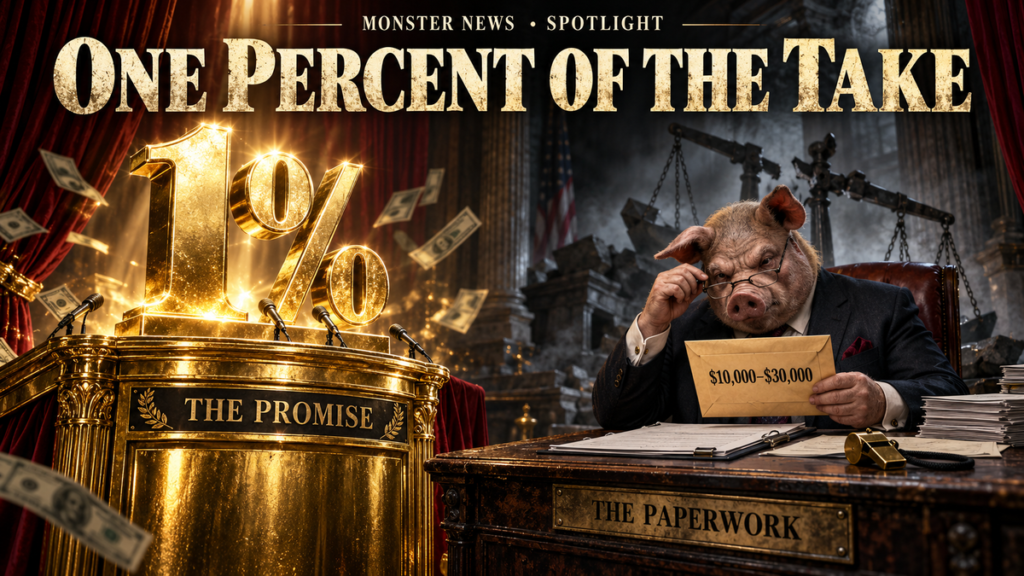
The White House promised a commission on fraud. The Justice Department wrote down a flat fee.
On Tuesday, 20 October, in the Oval Office, the President announced a program to pay Americans for finding fraud. Beside him stood Vice President JD Vance, who chairs the administration’s anti-fraud task force; Dr. Mehmet Oz, administrator of the Centers for Medicare and Medicaid Services; the chairman of the Federal Trade Commission; and Nick Shirley, the 24-year-old who filmed childcare centres in Minnesota and whose video the administration has credited as the basis for cutting federal funding to that state.
Before the announcement was over, Shirley had been handed a cheque for $10,000.
The President described what people would get. “And if it’s $10 billion, $200 billion, $400 billion, we’re giving a 1 percent commission to that person,” he said, according to the published transcript of the remarks. Reporters heard the figure described as an unlimited 1% commission on the fraud reported. The President also said who would decide: “I will be the arbitrator of all of these decisions. I will be very generous, believe me. We’re not looking to save on that.”
The Justice Department described the program differently, in writing, the same day.
What was written
The Fraud Whistleblower Incentive Program — WHIP — is run by DOJ’s National Fraud Enforcement Division. It is a three-year pilot, funded by a $25 million commitment from the Treasury. DOJ states that it rests on its authority under 28 U.S.C. § 530C(b)(1)(L), and that it follows Directive 26-12 of 1 October, which told division leadership to design programs that pay people — including people who took part in the misconduct — to bring forward credible information about fraud.
What it actually pays, per DOJ’s published guidance and the legal analyses that followed within a day:
- $10,000 to $30,000 for each distinct tip — a fixed range, not a percentage of anything.
- Paid at charging, when DOJ files and unseals an indictment, an information, or a criminal complaint. Not at conviction. Not at recovery. Not after appeal.
- At DOJ’s “sole discretion,” in the department’s own words.
- No minimum loss threshold. A scheme that took $40,000 qualifies exactly as a scheme that took $40 million does — same range.
Coverage is federal health care offences and fraud against programs run by Agriculture, Labor, Health and Human Services, Housing and Urban Development, Education, Veterans Affairs and the Small Business Administration. DOJ says it will prioritise hospice, home health care, day care and special services fraud. Only individuals can claim. The information must be original, given in writing, and the tipster must cooperate. People who meaningfully took part in the crime are ineligible, though minimal participants may be considered at DOJ’s discretion. Compliance officers, auditors, officers and directors are generally shut out — with exceptions, including an imminent-harm exception and one that opens after 120 days have passed since an internal report.
So: two descriptions of one program, four days apart in public understanding. A percentage with no ceiling, according to the podium. A capped finder’s fee, according to the paper.
Both can be true at once only if they are two different things — an announced intention to pay 1%, and an existing pilot that pays $30,000 at most. What has been created so far is the second. Monster News could find no bill in Congress that writes the 1% into law. As of this writing, the 1% is a promise made in a room, and the $10,000 to $30,000 is the policy that exists.
What the law already pays
This is where the announcement becomes more interesting than the coverage of it, and less generous than it sounds.
The United States has run a fraud bounty since 1863. The False Claims Act lets a private person bring suit on the government’s behalf — a qui tam action — and, if money is recovered, the court awards that person 15% to 30% of it: 15% to 25% where the government takes over the case, and 25% to 30% where it declines and the whistleblower carries it alone (31 U.S.C. § 3730(d)). The statute forbids retaliation against an employee who files (§ 3730(h)), requires the case to be filed under seal so the government can investigate quietly, and bars copycat suits on information already public (§ 3730(e)(4)). Illinois has its own version, the Illinois False Claims Act, 740 ILCS 175, paying the same 15% to 30% on state money — including Medicaid.
Put the numbers beside each other. A $5 million scheme:
- Promised at the podium: 1% — $50,000.
- Available under the written pilot: $30,000, paid when charges are filed.
- Available under the 1863 statute: $750,000 to $1,500,000, paid out of the recovery, with a court setting the amount and a statute protecting the claimant’s job.
That is not a small difference in design. It is a different theory of what a tip is worth.
The case for it — and it is a strong one
The argument for paying people to hunt fraud does not depend on the 1% figure, and it deserves to be stated at its best, because it is the reason this program exists and the reason it will probably find things.
Existing rewards arrive too late to change behaviour. A qui tam case is a multi-year project. It needs a lawyer willing to front costs. It sits under seal. The relator’s share lands after resolution, forfeiture and appeal — often five to seven years after the tip. A program that pays $10,000 six weeks after an indictment changes the arithmetic for the person who is deciding whether to make a phone call this month. The Justice Department frames this as the program’s central distinction, and it is a real one.
It reaches the fraud that inspectors general cannot see. State agencies administer federal money through thousands of small providers — day care centres, home health agencies, hospice operators, job-training contractors. Oversight is a sampling exercise. Nick Shirley walked into childcare centres with a camera and asked questions that a desk audit does not ask, and though the Minnesota Department of Children, Youth, and Families called parts of his video misleading and exaggerated, one Minneapolis woman whose centre he profiled later pleaded guilty to fraud. One viral video producing one guilty plea in one state is not proof of systemic rot. It is proof that the inspection model misses things a determined outsider can find.
It is the model that already works elsewhere. The IRS pays 15% to 30% of collected proceeds above $2 million under § 7623. The SEC pays 10% to 30% under § 21F. Both programs exist because Congress concluded that insider knowledge does not surface on its own, and that the public recovers more with a bounty than without one. The administration is extending a proven tool to a category of fraud — health care and benefits — where the losses are enormous and the whistleblowers are often the only witnesses.
And the no-minimum-loss rule is quietly the most interesting part. Because there is no threshold, the program is aimed at small local schemes, not just headline defendants. A rural county with a hospice agency billing for patients who are not dying is precisely the target. So is a daycare that invoices for children who never attend. The program pays the same $10,000 for finding one of those as for finding a national chain — and in a county of 16,000 people, one of those is the whole story.
On that reading, the program is not a gimmick. It is an attempt to crowdsource the audit function, and it may well work.
What the structure does that the argument doesn’t
Three things in the written program undercut the case being made for it at the podium.
Payment is severed from recovery. The fee follows charges, not money. A tip that produces an indictment which later collapses still pays. A scheme that is charged and never recovers a dollar still pays. The old statute ties the reward to what the public actually gets back; this one ties it to a prosecutor’s decision to file — which is a lower, faster and more discretionary event. That is the source of its speed, and also the reason it can pay for accusations rather than results.
Discretion is the whole mechanism. “Sole discretion” is DOJ’s phrase. The President’s phrase was that he would be the arbitrator, and that he would be very generous. A bounty that a named official decides case by case, for a program in a department he leads, is not a statutory entitlement — it is a grant. That is not automatically corrupt. It is, however, a different thing from the False Claims Act, where a judge fixes the percentage by formula and the claimant can appeal. For a program whose purpose is to make reporting safe and predictable, discretion is the weak point: it means the reward depends on who is deciding, and it can be withdrawn from the next person who asks.
The road not taken has a trap in it. A person who suspects fraud now has three doors: the DOJ tip line, a qui tam lawyer, or nothing. The program tells them nothing about how a WHIP submission interacts with a later False Claims Act suit. Filing with the government can amount to a public disclosure that bars a qui tam claim under § 3730(e)(4); the first-to-file rule can hand the case to whoever filed first. For a $5 million scheme, a $10,000 to $30,000 tip fee is a rounding error against a potential $750,000 relator share — and a person who takes the fast money without asking may be trading away the larger claim. The guidance does not warn them. Nothing in the announcement did either.
There is also the matter of what the incentive does to the accused. The program pays before anyone is convicted, at DOJ’s discretion, for information that prosecutors find credible. Fraud is real, and so are mistaken and malicious accusations against small providers who cannot afford to defend themselves. The False Claims Act’s answer to that is a court and a seal. This program’s answer is a prosecutor’s charging decision.
If you think you have found fraud
Monster News is not a law firm and cannot advise you. What follows is what the public record shows, so you can ask better questions.
If the money involved is federal — Medicare, Medicaid, daycare assistance, housing, veterans’ programs, farm programs — you may have a claim under the False Claims Act, and the share is 15% to 30% of what is recovered. If it is state money, the Illinois False Claims Act applies, at the same percentages. Those claims take years and generally need a lawyer who works on contingency. Before you sign anything with a tip broker or a “fraud club,” ask what happens to your qui tam rights, who gets the fee, and whether your identity stays sealed.
If you want the faster route, DOJ’s program pays $10,000 to $30,000 per tip at charging, at its discretion, and requires original information in writing and cooperation. Both doors can be considered. They are not the same door, and the difference is measured in hundreds of thousands of dollars on a mid-sized case.
And if what you have is a suspicion and a camera, the last four days have shown both halves of the truth: that an outsider can find what an agency missed, and that the reward for finding it may be smaller, later and more conditional than the person who thanked you on television said it would be.
The question
The interesting question is not whether America should pay people to find fraud. It already does, and has since Lincoln. The question is whether a bounty should be a statute with a formula, a seal and a retaliation clause — or a pilot with a ceiling, a pot of $25 million, and one man’s discretion.
The podium promised the first. The paperwork created the second. If the 1% is real, it needs a bill, and the bill needs to say what happens to the person who reported first, what protects them afterwards, and what happens when the accusation is wrong.
Until then, the strongest incentive in American fraud law remains the one that has been on the books for 163 years, and it pays fifteen to thirty times what the new program does.
Sources: Reuters, 20 October 2026 (announcement, figures, quotations); U.S. Department of Justice, Fraud Whistleblower Incentive Program announcement and guidance, 20 October 2026; Directive 26-12, 1 October 2026; Ballard Spahr legal alert, 21 October 2026 (program mechanics, 28 U.S.C. § 530C(b)(1)(L), eligibility); The Hill, 20 October 2026; KSL, 21 October 2026; 31 U.S.C. § 3730; 740 ILCS 175; 26 U.S.C. § 7623; 15 U.S.C. § 78u-6.
Comments
Sign in with Google to comment. Your comment posts immediately and is reviewed afterwards. Your address is never published.